A Zepbound tracker
that shows what the weight was made of.
IN SUMMARY
A Zepbound app should do more than log the shot. Zepbound is tirzepatide, the same molecule as Mounjaro, dosed weekly on a ladder from 2.5 mg to 15 mg. In pooled DEXA and MRI trials, about a quarter of the weight lost on it was lean mass rather than fat. The substudies behind that number are on The Science.
Bild Health is the Zepbound tracker built around that number. The schedule and every dose change are dated in the same record as fat and lean mass measured from your scale through Apple Health and Health Connect. DEXA scans import as checkpoints, and the protein target is sized at 2.4 g per kilogram of fat-free mass in a deficit. A shot log tells you that you injected. This tells you what the weight you lost was made of.
What a Zepbound app should actually show you
- 01
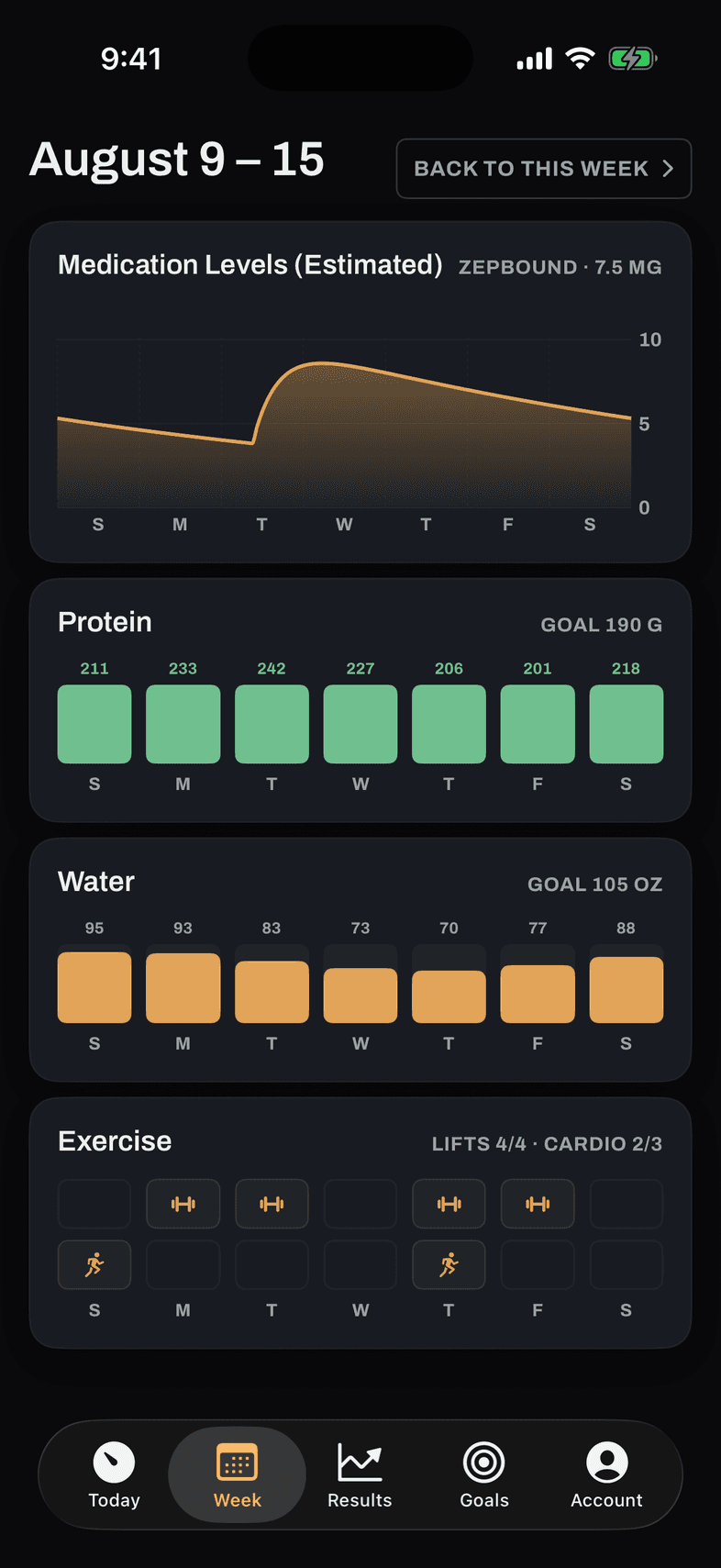
The schedule, drawn as a curve
Weekly injections do not produce a flat week. The medication-levels card charts the schedule you have logged, so the shape of the week is visible rather than assumed.
- 02
Fat and lean as separate lines
Scale weight is a sum. The whole question on this medication is which of its two parts moved, and that needs two lines, not one.
- 03
Each stretch read on its own
The label permits an increase only after at least four weeks on a dose. Bild Health charts change over one, three or six months, or the whole run: the window you pick, not one flattened average.
- 04
Protein sized to the tissue, not the total
Not to scale weight. As composition shifts underneath you, the target moves with it, which is the point of measuring lean mass at all.
- 05
DEXA results on the trend line
A scan is the accurate reading; a body-composition scale is the frequent one. Connect a BodySpec account or upload a report PDF from any provider, and each scan is marked as a fixed point your daily estimate has to answer to.
- 06
One record to bring to the appointment
Your doses and your measured fat and lean trends in one exportable record, in date order: the version of the question a prescriber can work with.
What the trials report about tirzepatide and lean mass
Zepbound's label makes a single qualitative statement about body composition and attaches no numbers to it. The numbers come from the trial literature, and they are population figures, which is the argument for measuring your own.
95% CI 22.8–28.0, from a 2026 meta-analysis restricted to DEXA and MRI studies. Tirzepatide is the one molecule in this class with real body-composition data behind it.
Pooled by medication in DEXA and MRI trials: 25.4% on tirzepatide up to 35.2% on semaglutide, and 17.5% once resistance training is added. The spread is the finding: the proportion is not a constant.
95% CI 14.2–20.8, the lowest lean-mass share of any arm in the same meta-analysis. Training and protein are the inputs still under your control while the schedule does its work.
Zepbound, charted properly
Two things Bild Health does with a weekly schedule that a shot logger has no way to do.
Two lines, because weight adds them together
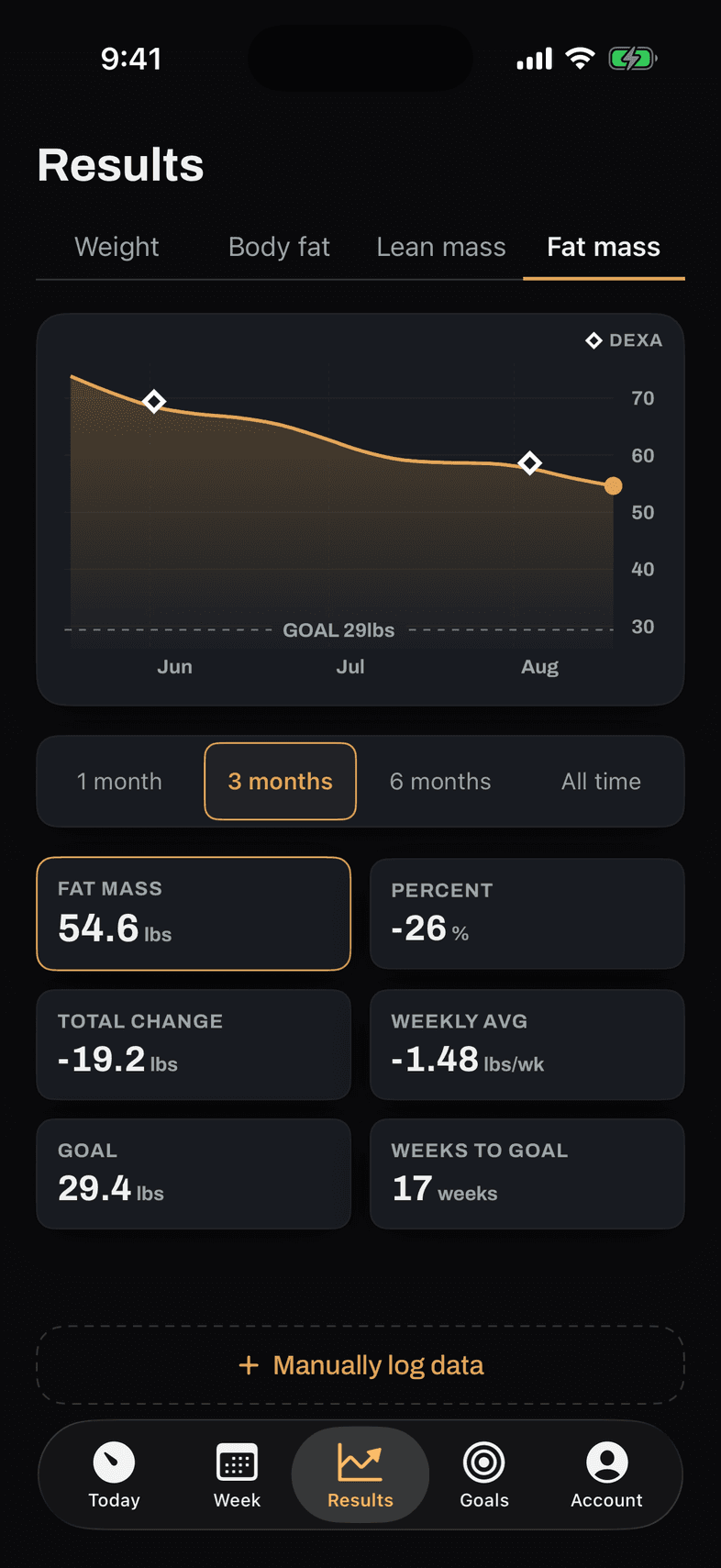
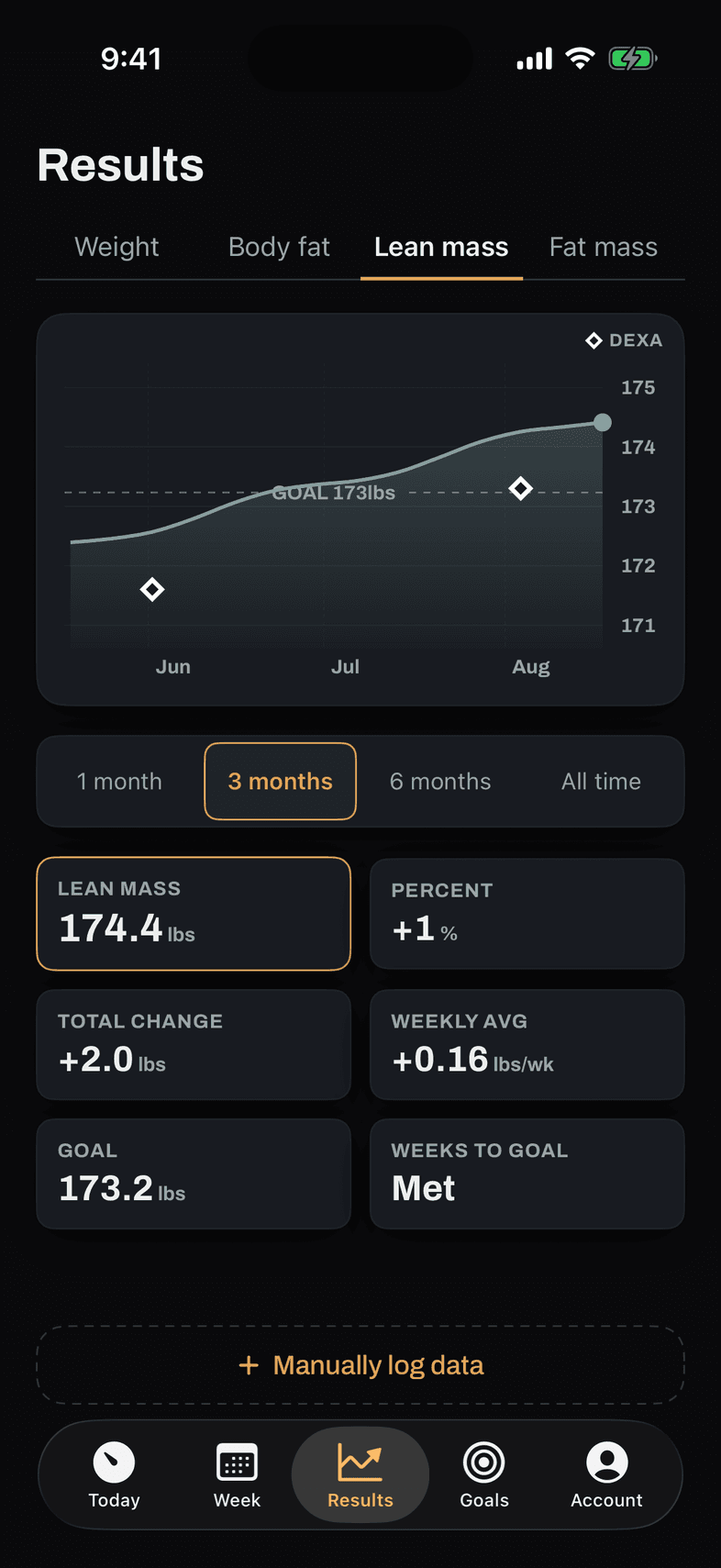
Total weight on this medication is going to fall, so it is the least informative number you own. Fat mass and lean mass are charted as separate series with their own goals. The interesting weeks are the ones where the two lines disagree: a flat weight hiding a trade, or a fast drop that is mostly fat.
- Fat mass and lean mass tracked as independent series
- A per-week rate on every Results tile, and a protein target re-run from your newest lean-mass reading
- Percent and absolute change over one, three, six months or all time
Log the shot where the consequences are visible
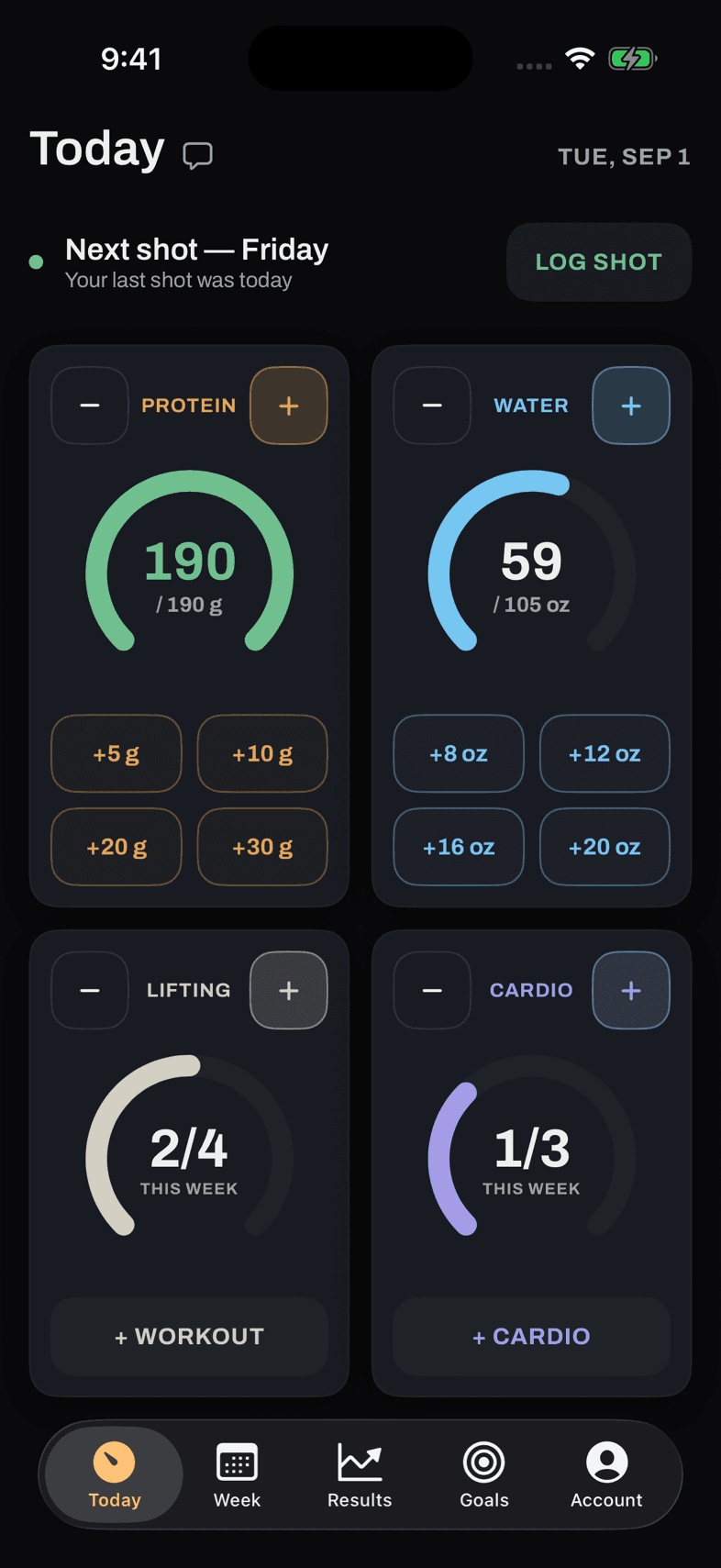
A shot log on its own is a compliance diary. Kept in the same record as the fat and lean series, it becomes a readout: the injection date, the protein you actually ate that week, the training you did, and the two lines those inputs produced.
- Injection date, dose and next shot due in one card
- Protein and training logged against the same days
- Nothing to reconstruct later from two apps and a memory
What the Zepbound label says, and what it leaves to you to measure
Zepbound is tirzepatide, made by Eli Lilly, and the label describes it in terms most summaries get wrong: it is “a glucose-dependent insulinotropic polypeptide (GIP) receptor and glucagon-like peptide-1 (GLP-1) receptor agonist”. Two receptors, not one. It is given as a subcutaneous injection once weekly, at any time of day, with or without food, in the abdomen, thigh or back of the upper arm.
Two indications, and the population for both is defined by weight
The first indication, as the label frames it, is use alongside a reduced-calorie diet and increased physical activity, to reduce excess body weight and maintain that reduction long term. It covers adults with obesity, and adults with overweight plus at least one weight-related condition. The second, added in December 2024, is moderate-to-severe obstructive sleep apnea in adults with obesity.
The phrase worth pausing on is maintain weight reduction long term. The label’s own goal is not a number on a scale at the end of a run; it is a durable change held over years. Over that horizon, what the loss was made of stops being academic. A maintained weight built on kept muscle is a different body from the same weight built on lost muscle, and a weight-only scale cannot tell those two apart.
Zepbound was approved on 8 November 2023 under NDA 217806. If you have seen 2022 quoted as its approval year, that comes from the “Initial U.S. Approval: 2022” line in the label header, which refers to tirzepatide the molecule, first approved as Mounjaro (the diabetes brand) in May 2022.
The dose ladder, as the label describes it
What follows is a transcription of the prescribing information, so that you can see the shape of the schedule the app charts. It is not a recommendation and it is not a plan. Escalation, pace and stopping are your prescriber’s decisions, and plenty of people move more slowly than the label permits, or settle part-way up.
| Point in the schedule | What the label states | How the label describes it |
|---|---|---|
| Weeks 1–4 | 2.5 mg once weekly | For treatment initiation, and expressly not approved as a maintenance dosage |
| After 4 weeks | 5 mg once weekly | The first of the named maintenance dosages |
| Any subsequent increase | Increments of 2.5 mg | Permitted after at least 4 weeks on the current dosage |
| Maintenance, weight reduction | 5 mg, 10 mg or 15 mg once weekly | All three are named as maintenance dosages |
| Maintenance, obstructive sleep apnea | 10 mg or 15 mg once weekly | The dosages named for the second indication |
| Maximum | 15 mg once weekly | The stated maximum for all indications |
Transcribed from the Zepbound prescribing information, NDA 217806, revised 02/2026. A description of what the label says, never a recommendation. Bild Health charts whatever schedule you are actually on.
Two more scheduling details, because an app that draws a weekly curve has to model them. The label describes a missed dose as one that may be administered within four days (96 hours) of the scheduled day, and otherwise skipped until the next scheduled dose. It also describes the day of the week as changeable, provided at least three days (72 hours) separate two doses. Both are label facts about the schedule, not instructions from us.
There is also a limitation of use worth knowing precisely because this molecule is sold twice: the label states that coadministration with other tirzepatide-containing products, or with any GLP-1 receptor agonist, is not recommended.
One sentence about body composition, and no numbers in it
Section 12.2 of the Zepbound label contains the only body-composition statement in it: tirzepatide “lowers body weight with greater fat mass loss than lean mass loss”. That is the whole of it. No percentages, no method, no population: a direction of travel and nothing more. Anyone quoting the label as the source of a fat-versus-lean split is quoting something it does not say.
The numbers live in the trial literature, and tirzepatide is the one molecule in this class with a real body-composition evidence base behind it. A 2026 systematic review and meta-analysis restricted to DEXA and MRI studies (20 randomised trials, 15,782 participants) reported lean mass at 25.4% of total weight lost across tirzepatide trials, with a 95% confidence interval of 22.8 to 28.0. A separate systematic review of 35 randomised trials across four incretin medications put the median at 28.3% of weight lost, with an interquartile range of 15.9% to 39.9%.
Read those two together and the useful conclusion is not a number but a spread. Roughly a quarter is the central estimate; the interquartile range is wide enough that people at either end of it are having materially different experiences of the same medication. That is the case for measuring rather than looking up.
Protein is the input the schedule works against
The awkward arithmetic of this medication is that the input most associated with holding on to fat-free mass is the one it makes hardest to hit. In a controlled energy deficit, trial arms at roughly 1.6 g/kg of protein lost proportionally less fat-free mass than arms at the recommended dietary allowance, with no further benefit from going higher again. Separately, in a small crossover study, spreading protein evenly across the day’s meals produced about a quarter more 24-hour muscle protein synthesis than concentrating it in one large meal, which matters most exactly when total appetite is limited and the shape of intake is one of the few variables left to you. The free protein calculator sizes the target the way the app does, and the full plan is in the keep-the-muscle guide.
Your label has two indications. A weight-only scale has one number.
Dose tracking is table stakes in this category and several apps do it well. None of them can put a measured lean-mass line underneath the schedule.
- Dose, date, injection site and next shot due
- Side effects and how the week felt
- A scale weight falling toward a goal
- One number that sums two tissues together
- The schedule charted as a weekly curve, step by step
- Fat mass and lean mass as independent series with their own goals
- DEXA checkpoints plotted against the daily trend
- Protein scaled to fat-free mass, floors at 80 g and 60 g
Where these numbers come from
- 01
Zepbound (tirzepatide) Prescribing Information
U.S. Food and Drug Administration · 2026 · NDA 217806 (Eli Lilly). Full prescribing information, revised 02/2026
- 02
Mounjaro (tirzepatide) Prescribing Information
U.S. Food and Drug Administration · 2026 · NDA 215866 (Eli Lilly). Full prescribing information, revised 01/2026
- 03
Diabetes, Obesity and Metabolism · 2026 · Eisa N, Barood O. Diabetes Obes Metab. 2026;28(6):4818–4827. doi:10.1111/dom.70666. PMID 41877354.
- 04
Effect of Incretin-Based and Nonpharmacologic Weight Loss on Body Composition
Annals of Internal Medicine · 2026 · Batsis JA, Gavras A, Gross DC, et al. Ann Intern Med. 2026;179(7):996–1013. doi:10.7326/ANNALS-25-00478
- 05
The FASEB Journal · 2013 · Pasiakos SM, et al. FASEB J. 2013;27(9):3837–3847
- 06
Dietary protein distribution positively influences 24-h muscle protein synthesis
The Journal of Nutrition · 2014 · Mamerow MM, et al. J Nutr. 2014;144(6):876–880
Zepbound tracking, answered
What is a Zepbound tracker?
A Zepbound tracker keeps your injection schedule and your body composition in one record, so a dose step and the tissue underneath it can be read on the same dates. Bild Health charts the medication schedule you are on alongside fat mass and lean mass as separate series, which is the pairing a shot log and a weight-only scale cannot produce between them.
When was Zepbound approved?
Zepbound was approved on 8 November 2023 under NDA 217806, and the obstructive sleep apnea indication was added on 20 December 2024. The label header reads 'Initial U.S. Approval: 2022', which trips people up constantly. That line refers to tirzepatide the molecule, first approved as Mounjaro in 2022, not to Zepbound.
Does Zepbound cause muscle loss?
Weight loss of any kind comes partly from lean tissue, and the pooled trial evidence for tirzepatide puts that share at about a quarter. A 2026 meta-analysis of DEXA and MRI trials reported lean mass at 25.4% of total weight lost across tirzepatide studies, with a 95% confidence interval of 22.8 to 28.0. What no study can tell you is your own proportion, which depends on your protein intake, your training and how fast the loss is happening.
How much of Zepbound weight loss is fat?
The label makes one qualitative statement, that tirzepatide lowers body weight with greater fat mass loss than lean mass loss, and attaches no numbers to it. For numbers you have to go to the trials: pooled tirzepatide studies put lean mass at about a quarter of weight lost, with the remainder fat. Both are population figures. The only fat-versus-lean split that describes you is the one measured on you.
Can I track my Zepbound dose and my body composition in one app?
That is what Bild Health is built for. Injections and dose changes are dated in the same record as fat mass, lean mass, protein and training. A change in the lines can be read against a change in the schedule, not reconstructed later from two apps and a memory.
How does Bild Health measure lean mass?
It reads what you already measure. A body-composition scale (a smart scale that estimates fat and lean, not just weight) feeds daily readings through Apple Health and Health Connect. DEXA scans pull in from a connected BodySpec account, or from a report PDF from any provider, and land as fixed points on the trend line. The lean-mass number behind your protein target is your newest reading, and the target restates only when that number has moved enough to matter. The scan anchors the estimate; the daily cadence is what makes a four-week comparison trustworthy.
The label's goal is long term. So is the muscle question.
Chart your Zepbound schedule against measured fat mass and lean mass, and find out which tissue the weight came from while you can still do something about it.
Lose the fat. Keep the muscle.