An Ozempic tracker
that shows fat vs. muscle.
Rungs as published in the FDA label. Figures shown are an illustration of a block-to-block comparison.
IN SUMMARY
An Ozempic app has one honest job the label cannot do: say what the weight you are losing is made of. Ozempic is semaglutide, Wegovy's molecule at a 2 mg weekly ceiling, and in pooled DEXA and MRI trials roughly a third of the weight lost on semaglutide was lean mass. The proportion is pooled separately from the trials of other molecules, not compared head to head; the trials themselves, by method, are on The Science.
Bild Health tracks the weekly schedule beside measured fat-mass and lean-mass lines: readings from a body-composition scale (a smart scale that estimates fat and lean, not just weight) through Apple Health and Health Connect, DEXA scans imported as fixed checkpoints, protein sized to fat-free mass, training on the same days. The proportion in the trials is an average; the only split that describes you is the one measured on you.
What an Ozempic app should put in front of you
- 01
The ladder that matches your label
Bild Health's Ozempic dose list carries four rungs (0.25, 0.5, 1 and 2 mg weekly) because that is what the prescribing information describes. The schedule you chart is the one on your label.
- 02
Fat and lean, held apart
Weight is one number made of two answers. Bild Health charts fat mass and lean mass as separate series, so the scale falling and the tissue holding are two different findings.
- 03
Every injection in the record
The label describes one injection a week on the same day. Each shot, each dose change and each skipped week is dated in the same record as your composition lines.
- 04
A target that tracks your fat-free mass
Not to scale weight. As appetite falls, the target holds against the tissue it is meant to protect: the number a weight-only tracker has never had the data to compute.
One ceiling, one proportion
The two facts this page is built on: what the Ozempic label describes, and what pooled trials of semaglutide report about the tissue behind the weight.
The published schedule starts at 0.25 mg for four weeks, moves to 0.5 mg, and describes steps to 1 mg and then 2 mg after at least four weeks at each. Two milligrams is the ceiling; 2.4 mg and 7.2 mg belong to the Wegovy label.
From a 2026 meta-analysis of 20 randomised trials and 15,782 participants, restricted to DEXA and MRI measurement (95% CI 31.5 to 38.9). Pooled across studies rather than measured head to head, and a wide spread sits behind the average.
What the app does with a weekly schedule
Four things that only work when the dose record and the body-composition record are the same record.
Two lines instead of one number
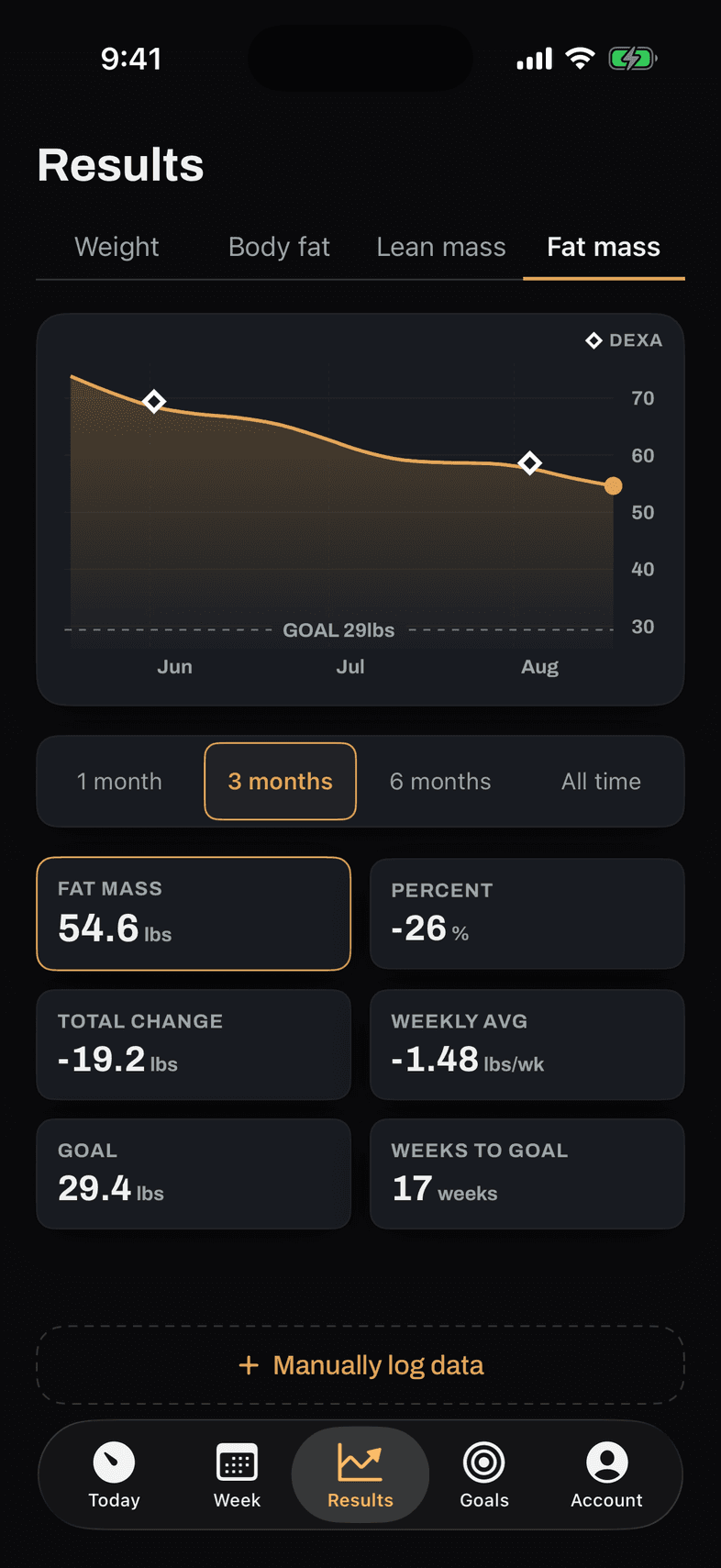
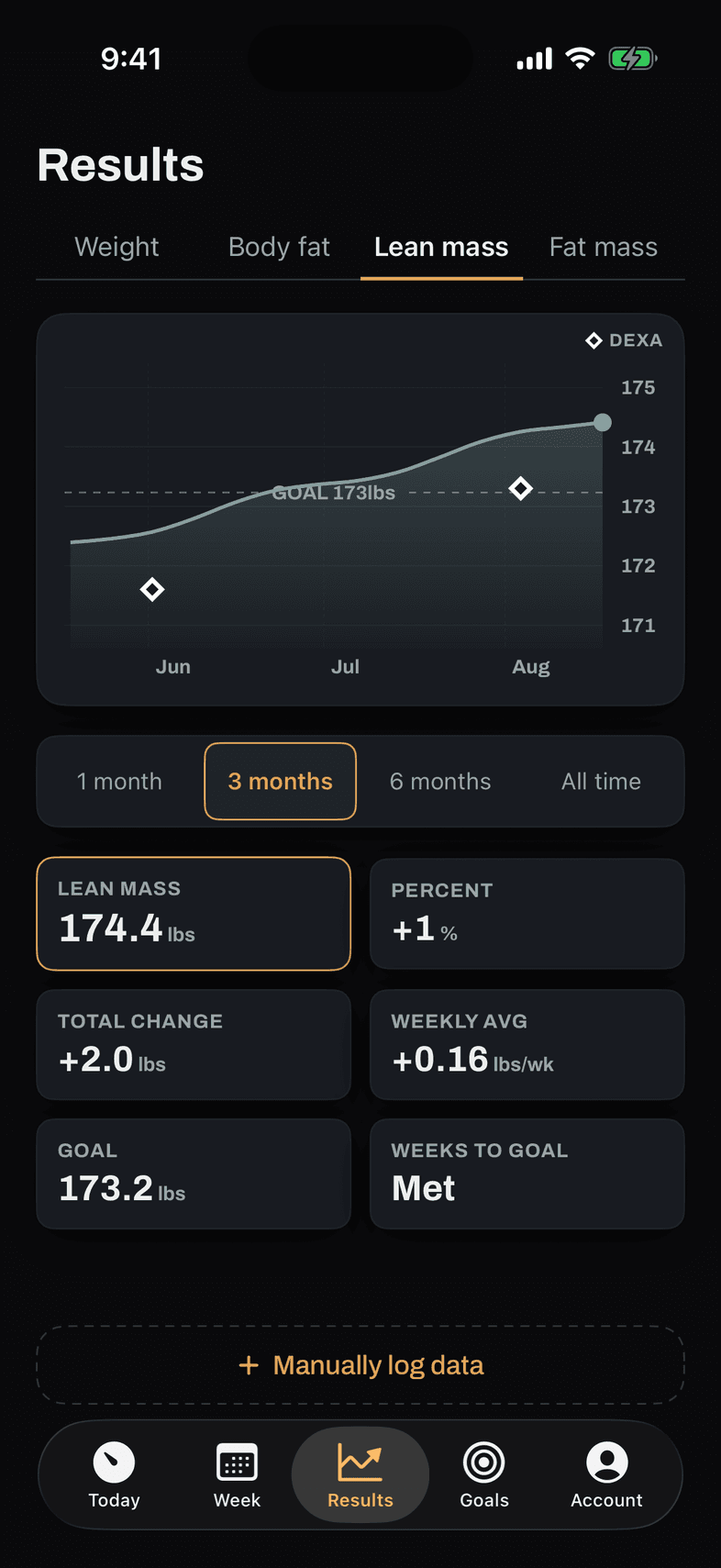
A weight-only scale hands you a single figure and leaves you to guess what it was made of. Bild Health keeps fat mass and lean mass as separate series from the first reading, so the question stops being how much you lost and becomes what you lost.
- Fat mass and lean mass charted independently, never as one total
- Dose steps and injections dated in the same record
- A per-week rate on every Results tile, and a protein target re-run from your newest lean-mass reading
The shot, the protein and the day in one screen
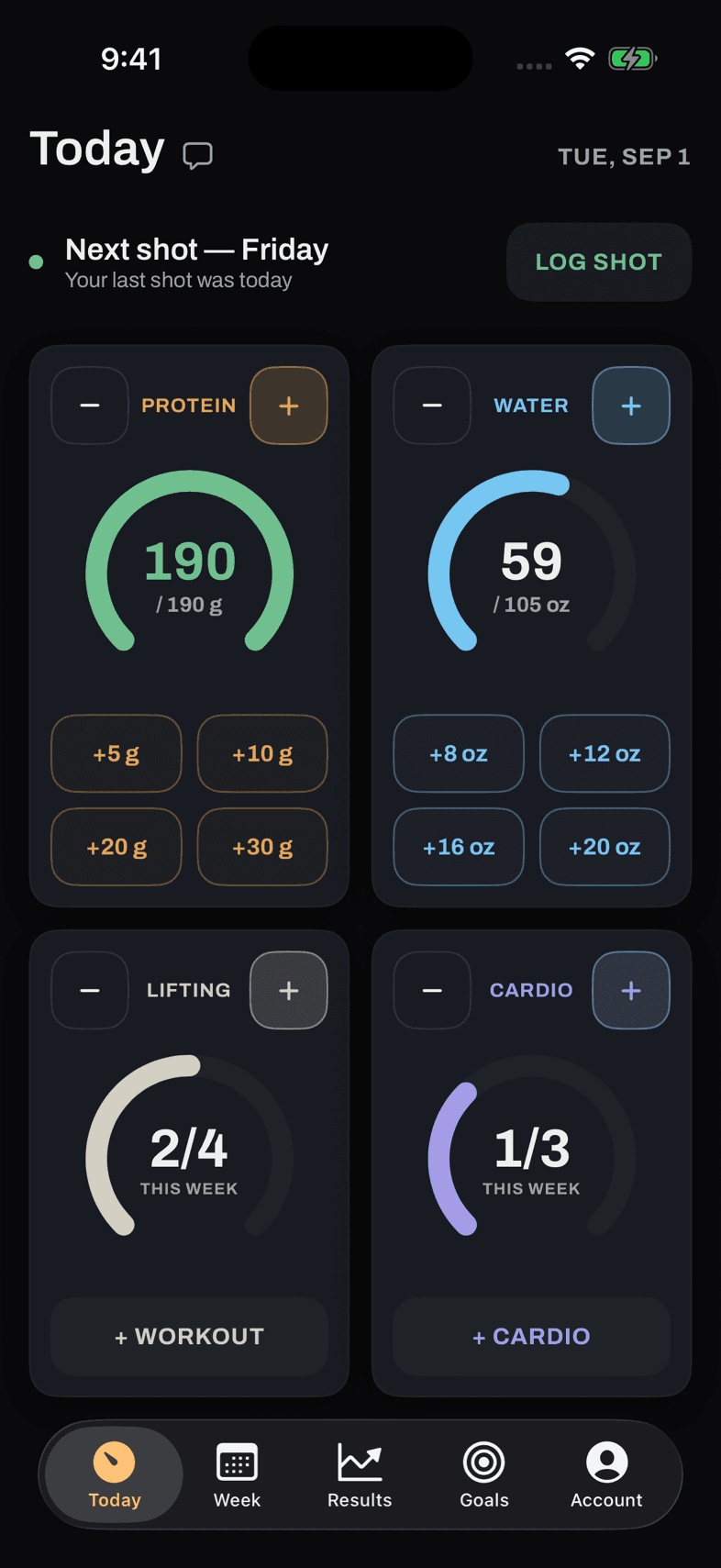
Injecting once a week makes the shot easy to place and easy to forget. Today shows the next shot, protein eaten against the fat-free-mass target, and lifting and cardio counted for the week: the inputs that decide what the lines do next.
- Weekly dose due, logged in a tap
- Protein tracked against a lean-mass-derived target
- A skipped week recorded as a gap, not quietly smoothed over
The 2 mg ladder, and what it looks like on a chart
Ozempic is the type 2 diabetes brand of semaglutide, approved under NDA 209637 and marketed by Novo Nordisk. Its label carries three indications and all three are scoped to type 2 diabetes: glycemic control as an adjunct to diet and exercise, reduction of major adverse cardiovascular events in adults with established cardiovascular disease, and reduction of the risk of sustained eGFR decline, end-stage kidney disease and cardiovascular death in adults with chronic kidney disease. Weight reduction is not among them. That is the Wegovy label, a separate application for the same molecule.
Which matters here for one practical reason. Whatever the label is scoped to, the weight comes off, and the weight is made of two tissues. A record that knows only the total cannot tell you which one moved.
The schedule as the label publishes it
| Stage | Once-weekly dose | What the label says |
|---|---|---|
| Weeks 1–4 | 0.25 mg | Initiation. The label states this dose is not for glycemic control |
| From week 5 | 0.5 mg | The first dose the schedule describes for glycemic control |
| After at least 4 weeks at 0.5 mg | 1 mg | Described where additional glycemic control is needed |
| After at least 4 weeks at 1 mg | 2 mg | The maximum dose in the label |
Transcribed from the Ozempic prescribing information (NDA 209637, revised 05/2026), read in full on 2026-07-31. The same label describes 1 mg weekly as the maintenance dose for adults with type 2 diabetes and chronic kidney disease, after at least four weeks at 0.5 mg. This is a description of a published schedule, not a recommendation: what you take, and when it changes, is a decision for your prescriber.
Why the ceiling is the thing a tracker has to get right
Two milligrams is where the Ozempic schedule ends. The figures people most often type into a tracker instead (2.4 mg, and since March 2026 the 7.2 mg Wegovy HD dose) come from a different label entirely. The gap between the two ceilings is roughly 3.6 times, and a tool that offers you a rung your label does not describe is inviting you to chart a schedule you are not on. Bild Health carries the four Ozempic rungs under Ozempic, and Wegovy’s under Wegovy.
| Ozempic | Wegovy | |
|---|---|---|
| Application | NDA 209637, injection | NDA 215256 injection and NDA 218316 tablets, one shared label |
| What the label covers | Type 2 diabetes: glycemic control, cardiovascular risk in established CV disease, kidney outcomes in chronic kidney disease | Weight reduction and long-term maintenance, cardiovascular risk reduction, and noncirrhotic MASH with F2–F3 fibrosis |
| Form | Weekly subcutaneous injection | Weekly subcutaneous injection, or a once-daily tablet |
| Highest dose in the label | 2 mg weekly | 7.2 mg weekly injection, or 25 mg daily tablets |
Both prescribing informations read in full on 2026-07-31. Wegovy's MASH indication was granted under accelerated approval, and the label notes continued approval may be contingent on a confirmatory trial. Brand names are used to identify the medications our users track.
There is a third product in the same family worth naming, because the name invites the confusion. Ozempic tablets are oral semaglutide under NDA 213051: the renamed Rybelsus formulation, with its own strengths, its own schedule, and a type 2 diabetes indication. The label states the two tablet products are not substitutable with each other milligram for milligram, and oral and injectable milligrams are not comparable either. If you are on the weight label rather than the diabetes one, the schedule tops out differently. The app charts either label’s ladder from the doses you log.
What each part of the schedule asks of the chart
| What the label describes | What it means for the chart |
|---|---|
| One injection a week, on the same day each week | The dose series is a step function with weekly markers, not a daily line |
| Four weeks at 0.25 mg before any change | The opening block moves fast and carries fluid with it: an early lean-mass dip is substantially water |
| At least four weeks at each dose before the next | Four-week blocks are the comparison unit: average against average, never week against week |
| A missed dose taken within five days, or skipped | Gaps belong in the record: a fortnight with one shot in it explains a lot of chart |
| A ceiling of 2 mg | The escalation ends and the measurement doesn't: the flat stretch after it is the most readable part of the run |
Left column as published; right column is how a measurement series behaves, not a prediction about any individual.
What the evidence says about lean mass on semaglutide
The Ozempic label is silent on body composition: there is no fat-mass or lean-mass statement anywhere in it. So the question has to be answered from trials, and two 2026 syntheses are the best available. A meta-analysis of 20 randomised trials in 15,782 participants, restricted to DEXA and MRI measurement, reported lean mass at 35.2% of total weight lost across semaglutide trials, with a 95% confidence interval of 31.5 to 38.9. A separate systematic review of 35 incretin trials put the median across the whole class at 28.3%, with an interquartile range of 15.9 to 39.9%.
Read those as what pooled trials of each treatment reported, not as a league table: the molecules were compared across studies rather than against each other in one, and the spread inside every estimate is wide enough to swallow the differences between them. What moves your own share is behavior, not brand. The levers are in the keep-the-muscle guide, and the protein target they start from has a free calculator. On tirzepatide instead? The ladder differs; the Zepbound tracker page covers it. The broader review also states its own honest limit plainly: no study in it reported objective physical function outcomes. What all of this establishes is that the proportion varies enormously between people, which is an argument for measuring yours rather than looking it up.
Your own share depends on protein intake, on resistance training, on age and on how fast the loss is happening. Three of those are inputs you control, and all four are legible on a chart that keeps lean mass as its own line.
A shot log proves you injected. It cannot tell you what the weight was made of.
Dose tracking is table stakes and several apps do it well. Most stop at the weight number; ours is built on a measured fat-and-lean split: a body-composition scale reading through Apple Health, anchored by DEXA.
- Dose, date, injection site and the next shot due
- Side effects and how the week felt
- A weight number moving toward a goal
- Nothing about which tissue the movement came from
- The published Ozempic rungs, dated in your record
- Fat mass and lean mass as separate series beneath them
- DEXA checkpoints plotted against the daily trend
- A protein target sized to your measured lean mass
Where these numbers come from
- 01
Ozempic (semaglutide) Prescribing Information
U.S. Food and Drug Administration · 2026 · NDA 209637 (Novo Nordisk). Full prescribing information, revised 05/2026
- 02
Wegovy (semaglutide) Prescribing Information
U.S. Food and Drug Administration · 2026 · NDA 215256 (injection) and NDA 218316 (tablets), Novo Nordisk. Combined prescribing information, revised 06/2026
- 03
Rybelsus / Ozempic tablets (semaglutide) Prescribing Information
U.S. Food and Drug Administration · 2026 · NDA 213051 (Novo Nordisk). Full prescribing information, revised 01/2026
- 04
Diabetes, Obesity and Metabolism · 2026 · Eisa N, Barood O. Diabetes Obes Metab. 2026;28(6):4818–4827. doi:10.1111/dom.70666. PMID 41877354.
- 05
Effect of Incretin-Based and Nonpharmacologic Weight Loss on Body Composition
Annals of Internal Medicine · 2026 · Batsis JA, Gavras A, Gross DC, et al. Ann Intern Med. 2026;179(7):996–1013. doi:10.7326/ANNALS-25-00478
Tracking Ozempic, answered
What is the maximum dose of Ozempic?
The Ozempic prescribing information describes a maximum of 2 mg once weekly. That is the number to check your tracker against, because the higher figures in circulation belong to a different product: 2.4 mg and 7.2 mg are Wegovy doses. Same molecule, different application, different label, different ceiling.
Is Ozempic approved for weight loss?
No. All three of the indications in the Ozempic label are scoped to type 2 diabetes: glycemic control alongside diet and exercise, reduction of major adverse cardiovascular events in adults with established cardiovascular disease, and reduction of the risk of sustained eGFR decline, end-stage kidney disease and cardiovascular death in adults with chronic kidney disease. Semaglutide's weight-management label is Wegovy, a separate application.
How long is the Ozempic dose schedule?
As published: 0.25 mg once weekly for four weeks to start, which the label says is not a dose for glycemic control, then 0.5 mg. From there the label describes an increase to 1 mg after at least four weeks at 0.5 mg, and to 2 mg after at least four weeks at 1 mg. Three four-week intervals therefore sit between initiation and the ceiling at the label's minimum spacing. How fast anyone actually moves is a decision for their prescriber.
Is Ozempic the same as Wegovy?
The active ingredient is the same, semaglutide from Novo Nordisk, and everything else differs. Ozempic is approved under NDA 209637 for type 2 diabetes with a ceiling of 2 mg weekly. Wegovy is approved separately for weight reduction and cardiovascular risk reduction, as a weekly injection or a daily tablet, and (injection only and under accelerated approval) for noncirrhotic MASH. Its maximum weekly injection dose is 7.2 mg. Treating one label's schedule as the other's is the most common mistake in this category.
What does the label say about a missed Ozempic dose?
The prescribing information describes taking a missed dose within five days of the scheduled day, and skipping it otherwise, with the next dose taken on the regular day. It also describes keeping at least two days between doses if the weekly day is being changed. Bild Health records a skipped week as a skipped week rather than smoothing it away, because a gap is part of the record you take to your prescriber.
Four rungs, one ceiling, two lines worth watching.
Keep your weekly schedule in the same record as your fat mass and your lean mass, and read the run as the sequence it actually is.
Lose the fat. Keep the muscle.