Glapp tracks how you feel.
Bild Health tracks your muscle.
Glapp focuses on how the week feels with six named shot phases, food noise, hunger, mood, sleep and energy logged against where you are in the injection cycle, with supply tracking and titration guidance. If an understanding of your week around the shot is what you need, Glapp is the better choice.
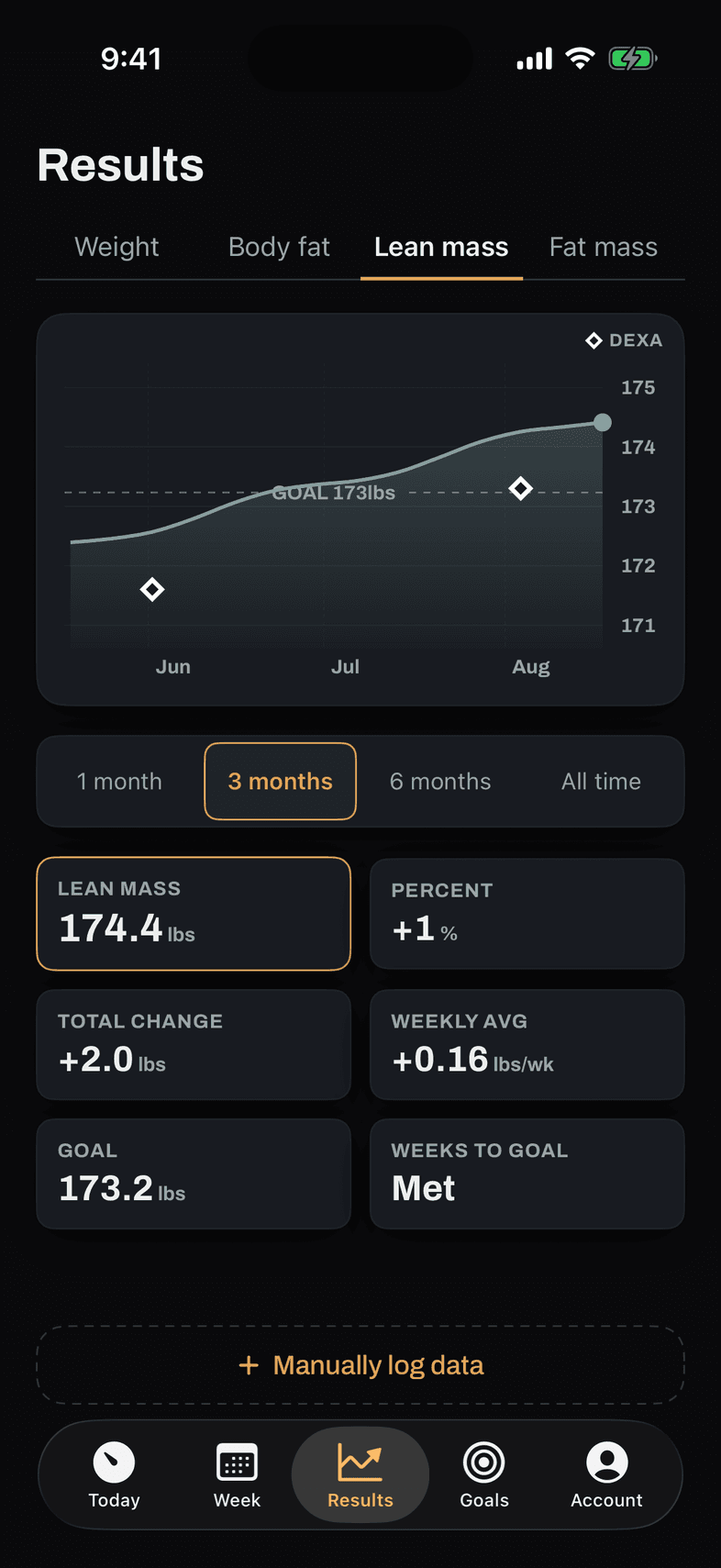
If you are concerned about muscle loss, Bild Health is for you. We center you on muscle-preservation goals with protein targets, lean mass & body fat tracking, DEXA scan imports and more.
Feature by feature
Glapp wins the felt-week rows and we have left them in. The rows that decide whether you keep your muscle are the ones underneath.
| Bild Health | Glapp | |
|---|---|---|
| Logs shots with dose, timing and site | Yes | Yes |
| Estimated medication level | Yes | Yes |
| Injection reminders | Yes | Yes |
| Food noise, hunger and mood by cycle phase | No | Yes |
| iPhone and Android apps | Yes | Yes |
| Apple Watch app | Yes | Yes |
| Syncs with Apple Health | Yes | Yes |
| A protein goal in the app | Yes | No |
| Sets a daily hydration target | Yes | No |
| Tracks lean mass | Yes | No |
| Tracks fat mass | Yes | No |
| Charts fat mass and lean mass as separate lines | Yes | No |
| Body-composition readings from a smart scale | Yes | No |
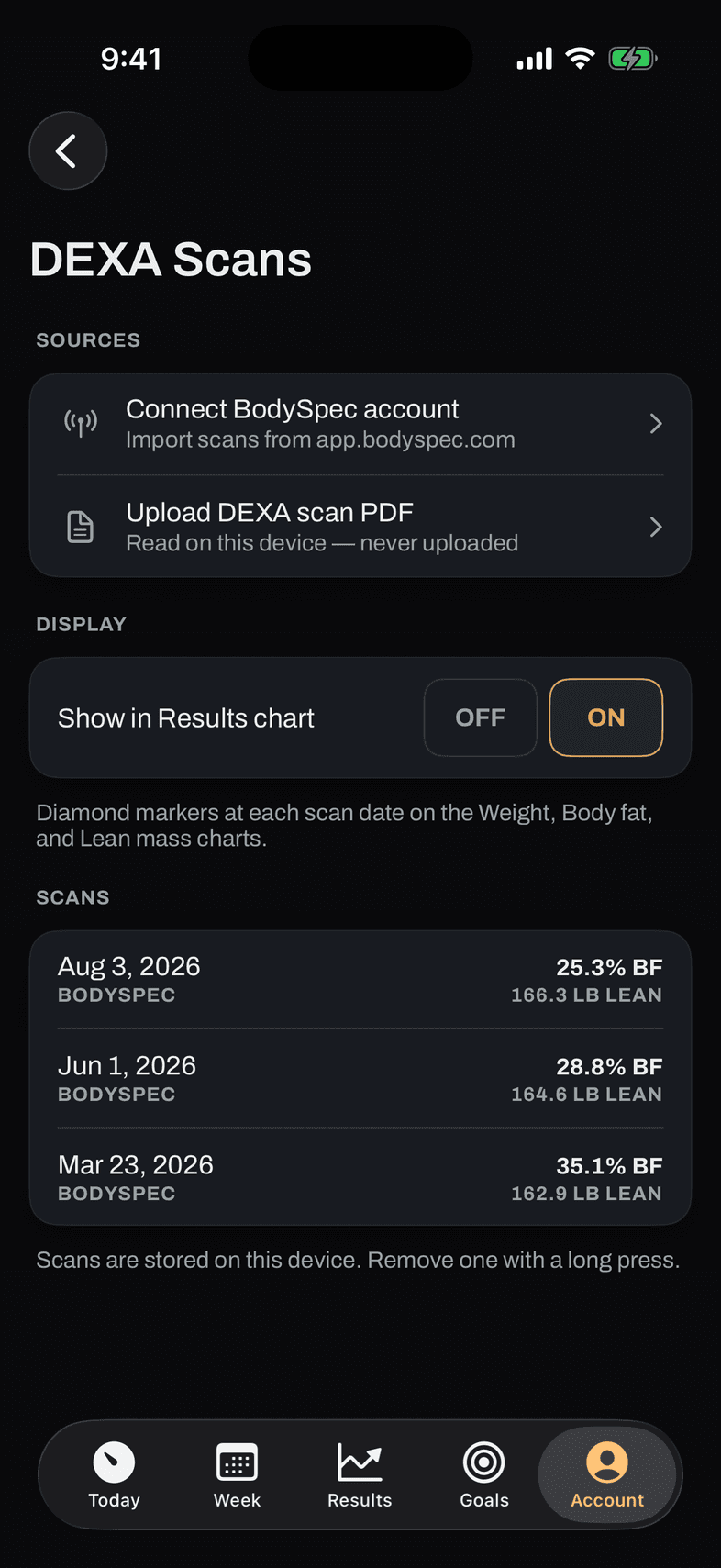
| Imports DEXA scans as checkpoints | Yes | No |
| Protein target sized to measured lean mass | Yes | No |
| Logs resistance training against the dose | Yes | No |
Sources and disclaimers
How the rows are scored
Why these rows decide it, with the trials behind each one: The Science.
A cross means the feature is absent from what Glapp publishes — glapp.io and its App Store listing, version 1.1.21 — and not proof the app cannot do it. On the body-composition rows that absence is total: body fat, lean mass, DEXA and smart scales appear nowhere in either. Its Apple Health sync is for weight. Glapp is community-built, organises everything around the shot cycle, and estimates medication level from a pharmacokinetic model — none of which is in dispute here. It positions away from macro counting by choice rather than by omission, which is why the protein and hydration rows cross rather than qualify. Glapp is free to download with a paid Glapp Max tier and publishes no pricing page, so this compares products rather than tiers.
Checked July 31, 2026. Every claim about Glapp on this page comes from Glapp’s own published feature and pricing pages, read on that date. Products change; if something here has gone out of date, tell us and we’ll correct it.
Where these numbers come from
- 01
Effect of Incretin-Based and Nonpharmacologic Weight Loss on Body Composition
Annals of Internal Medicine · 2026 · Batsis JA, Gavras A, Gross DC, et al. Ann Intern Med. 2026;179(7):996–1013. doi:10.7326/ANNALS-25-00478
- 02
Once-Weekly Semaglutide in Adults with Overweight or Obesity
New England Journal of Medicine · 2021 · Wilding JPH, et al. STEP 1. N Engl J Med. 2021;384(11):989–1002
- 03
Insufficient sleep undermines dietary efforts to reduce adiposity
Annals of Internal Medicine · 2010 · Nedeltcheva AV, et al. Ann Intern Med. 2010;153(7):435–441
- 04
Preserving Healthy Muscle during Weight Loss
Advances in Nutrition · 2017 · Cava E, Yeat NC, Mittendorfer B. Adv Nutr. 2017;8(3):511–519
- 05
Sarcopenia: revised European consensus on definition and diagnosis
Age and Ageing · 2019 · Cruz-Jentoft AJ, et al. EWGSOP2. Age Ageing. 2019;48(1):16–31
- 06
Diabetes, Obesity and Metabolism · 2026 · Eisa N, Barood O. Diabetes Obes Metab. 2026;28(6):4818–4827. doi:10.1111/dom.70666. PMID 41877354.
Up to 39% of the weight lost on a GLP-1 is lean mass, not fat.
There is a narrow path to losing weight and keeping or even gaining muscle. To do so you must lift heavy and consume a ridiculous amount of protein.
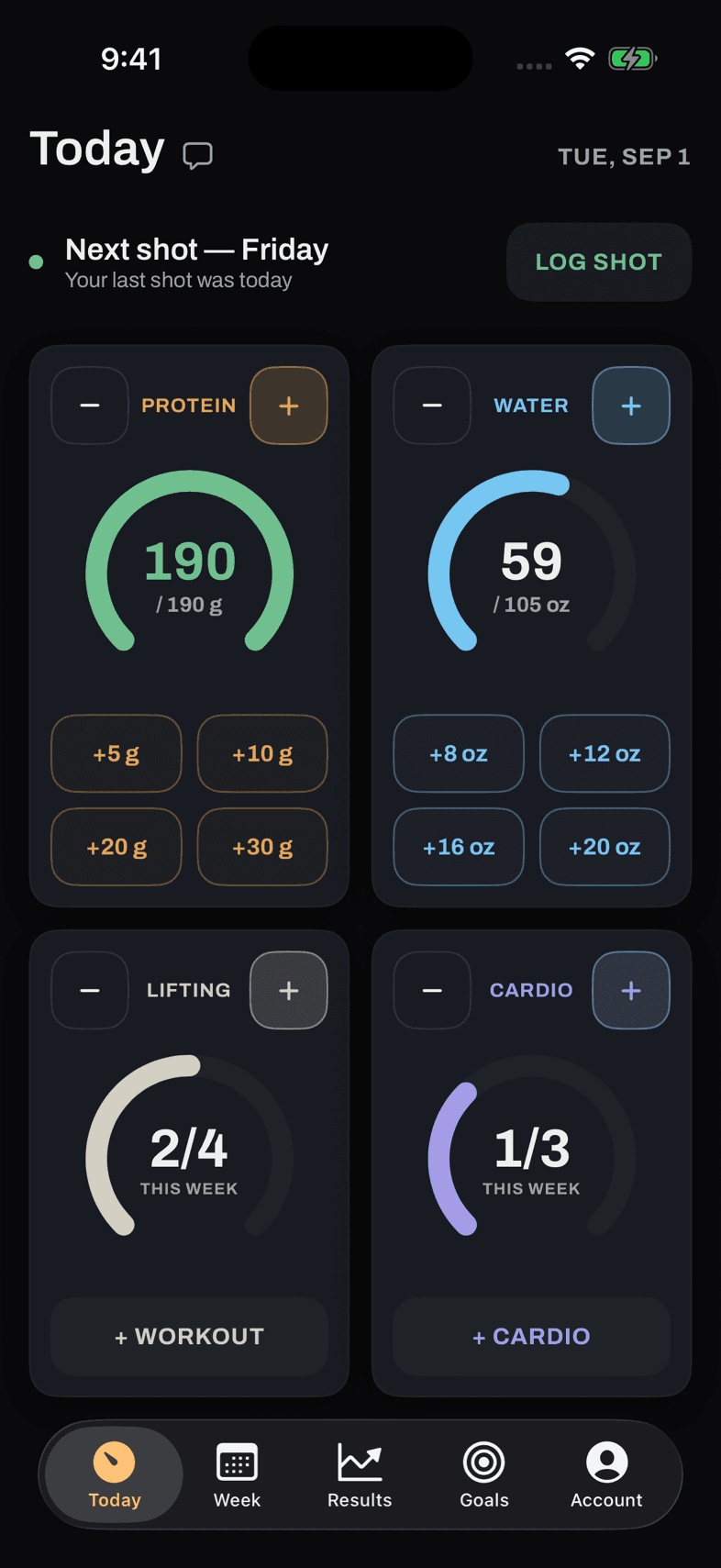
Track Protein in 1-Tap.
Consuming 140–180g of protein a day is very hard. Bild Health makes it easy to track how much you consumed each day with simple 1 tap logging for protein, hydration, and exercises. You can also track from your Apple Watch. Start with the free protein calculator.
Track Weight and Muscle
Bild Health integrates with smart scales to help you track not just your weight but your lean mass as well, track both together and adjust your exercise and protein intake based on your results. See what the split looks like with the muscle-loss calculator.
Import Your DEXA Scans
Smart scales are good, but the reference most of them are checked against for body fat and lean mass is the DEXA scan. Bild Health imports your scan results and adds these to your charts beside your scale readings, giving you more data on your fat loss progress. More on how the two compare in DEXA scans vs. smart scales.
Glapp alternatives, answered
Is Glapp free?
Not entirely, as of 2026. Glapp is free to download with in-app purchases, and Glapp Max, introduced in June 2026, is listed on the App Store at $4.99 weekly, $9.99 monthly and $39.99 annually. Community posts describing Glapp as 100% free date from before that launch. Glapp publishes no pricing page on glapp.io, so exactly which features sit in the free tier is best checked in the app itself.
Can I use Glapp and Bild Health together?
They compose better than most pairs, because they are not competing for the same screen: one records how the week after the shot went, the other records what your body is made of. The only thing worth avoiding is keeping two authoritative dose histories, since reconciling them later is miserable. Pick one app as the record of the shot. Bild Health logs doses, food and protein as well, so it also works as the only app on the phone.
Does Glapp set a protein target?
No, and it does not try to. Glapp positions itself away from calorie and macro counting on purpose: its own framing is about how your body feels rather than what you tally. That is a coherent product decision. It does mean the protein question, which is the main lever people have for holding onto muscle in a deficit, sits outside what the app is for.
How does Bild Health measure fat and lean mass?
From a body-composition smart scale synced through Apple Health and Health Connect, with DEXA scans as checkpoints, imported from a connected BodySpec account or a report PDF from any provider. The scale supplies cadence and the scan supplies the anchor.
How long before a lean-mass trend means anything?
Give it a dose step, about four weeks. A single reading tells you almost nothing, a week of readings gives you a direction worth glancing at, and a dose step is the natural comparison window: average against average, never day against day. A scan every few months keeps the whole series honest.
Does Bild Health log injections and dose steps?
Yes. Every injection and dose change is dated in the same record as the composition trend, because that pairing is the point. A dose history on its own is a compliance diary; read beside a lean-mass line, it tells you what each step up the ladder cost you, in pounds, while there is still time to act on it.
Keep the felt week. Add the muscle.
Bild Health charts fat mass and lean mass, anchors the trend to DEXA scans, keeps your dose history in the same record, and sizes your protein target to the lean number.
Lose the fat. Keep the muscle.