MeAgain tracks your meals.
Bild Health tracks your muscle.
MeAgain focuses on capturing your day: food by photo, voice or barcode, doses, injection sites, side effects and habits. If getting everything you eat into an app is your goal, MeAgain is the better choice.
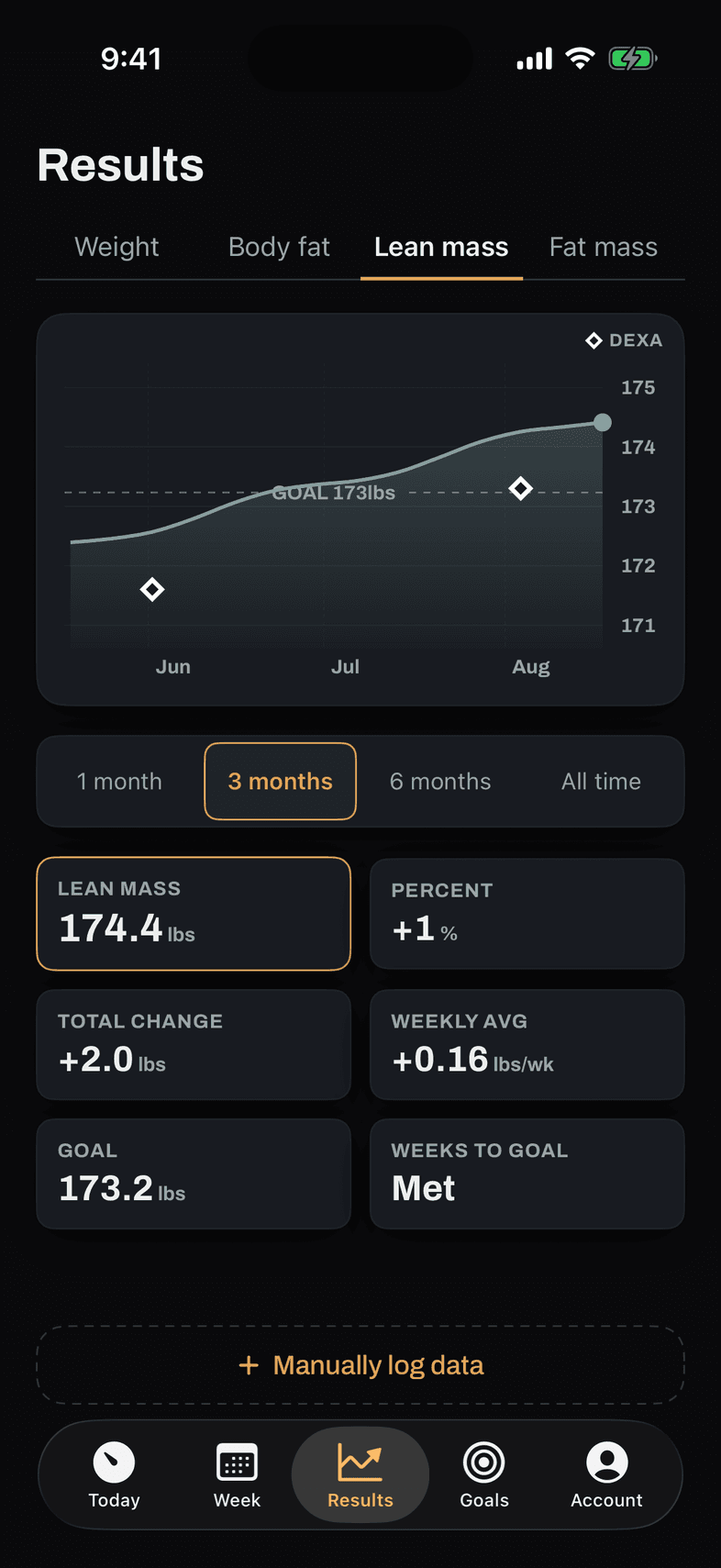
If you are concerned about muscle loss, Bild Health is for you. We center you on muscle-preservation goals with protein targets, lean mass & body fat tracking, DEXA scans and more.
Feature by feature
MeAgain wins the capture rows and we have left them in. The rows that decide whether you keep your muscle are the ones underneath.
| Bild Health | MeAgain | |
|---|---|---|
| Logs injections and GLP-1 pills | Yes | Yes |
| Injection-site logging and rotation | Yes | Yes |
| Estimated medication level | Yes | Yes |
| iPhone and Android apps | Yes | Yes |
| A protein goal in the app | Yes | Yes |
| Sets a daily hydration target | Yes | Yes |
| Tracks lean mass | Yes | No |
| Tracks fat mass | Yes | No |
| Charts fat mass and lean mass as separate lines | Yes | No |
| Body-composition readings from a smart scale | Yes | No |
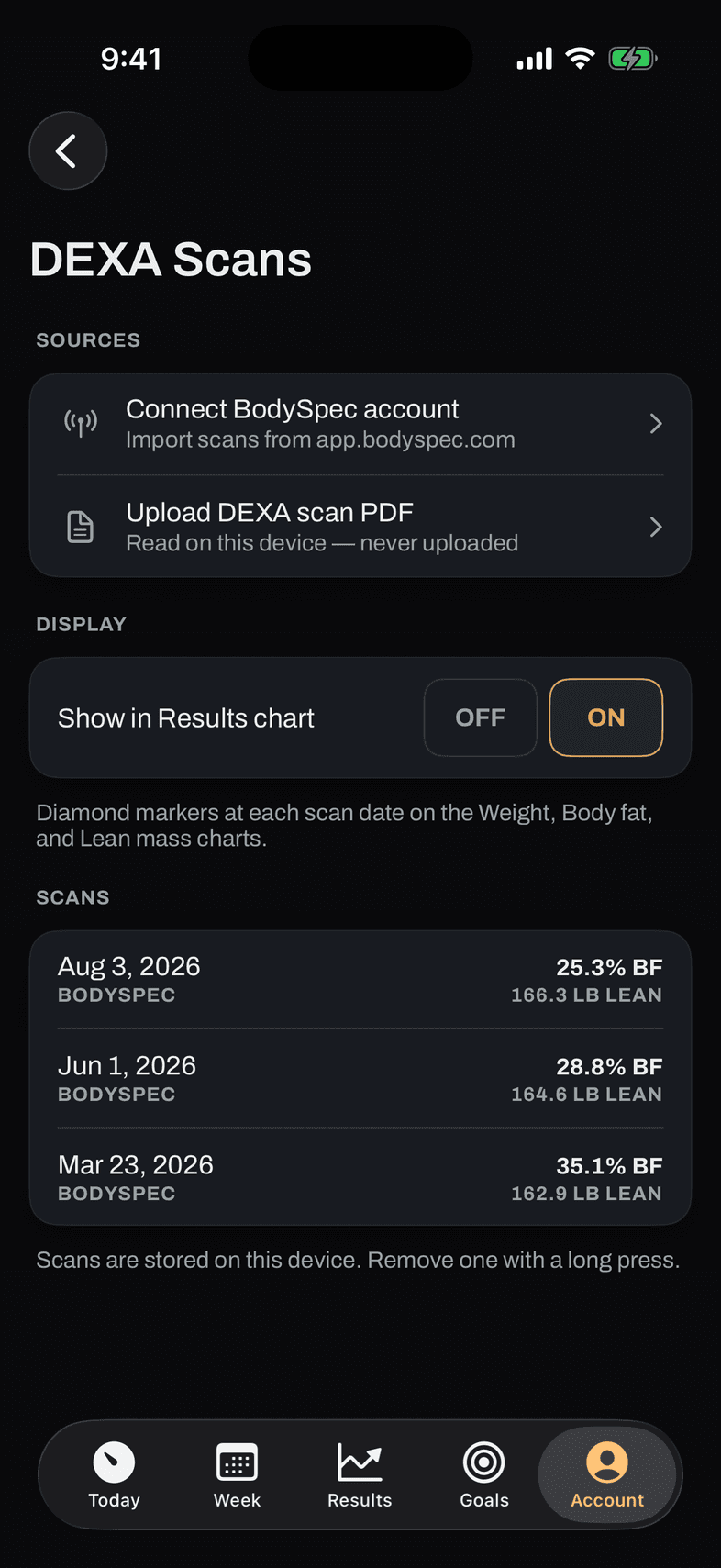
| Imports DEXA scans as checkpoints | Yes | No |
| Protein target sized to measured lean mass | Yes | No |
| Logs resistance training against the dose | Yes | No |
| Apple Watch quick-log app | Yes | No |
Sources and disclaimers
How the rows are scored
Why these rows decide it, with the trials behind each one: The Science.
A cross means the feature is absent from what MeAgain publishes — meagain.com and its App Store listing, version 2.2.5 — and not proof the app cannot do it. On the body-composition rows that absence is total: body fat, lean mass, DEXA and smart scales appear nowhere in either. MeAgain does publish protein, fiber and water goals, so those rows are ties; it does not publish the formula behind them, which is why the narrower lean-mass row is the one that crosses. This compares products rather than tiers.
Checked August 24, 2026. Every claim about MeAgain on this page comes from MeAgain’s own published feature and pricing pages, read on that date. Products change; if something here has gone out of date, tell us and we’ll correct it.
Where these numbers come from
- 01
Effect of Incretin-Based and Nonpharmacologic Weight Loss on Body Composition
Annals of Internal Medicine · 2026 · Batsis JA, Gavras A, Gross DC, et al. Ann Intern Med. 2026;179(7):996–1013. doi:10.7326/ANNALS-25-00478
- 02
Once-Weekly Semaglutide in Adults with Overweight or Obesity
New England Journal of Medicine · 2021 · Wilding JPH, et al. STEP 1. N Engl J Med. 2021;384(11):989–1002
- 03
The FASEB Journal · 2013 · Pasiakos SM, et al. FASEB J. 2013;27(9):3837–3847
- 04
International Journal of Sport Nutrition and Exercise Metabolism · 2014 · Helms ER, et al. Int J Sport Nutr Exerc Metab. 2014;24(2):127–138
- 05
Preserving Healthy Muscle during Weight Loss
Advances in Nutrition · 2017 · Cava E, Yeat NC, Mittendorfer B. Adv Nutr. 2017;8(3):511–519
- 06
Diabetes, Obesity and Metabolism · 2026 · Eisa N, Barood O. Diabetes Obes Metab. 2026;28(6):4818–4827. doi:10.1111/dom.70666. PMID 41877354.
Up to 39% of the weight lost on a GLP-1 is lean mass, not fat.
There is a narrow path to losing weight and keeping or even gaining muscle. To do so you must lift heavy and consume a ridiculous amount of protein.
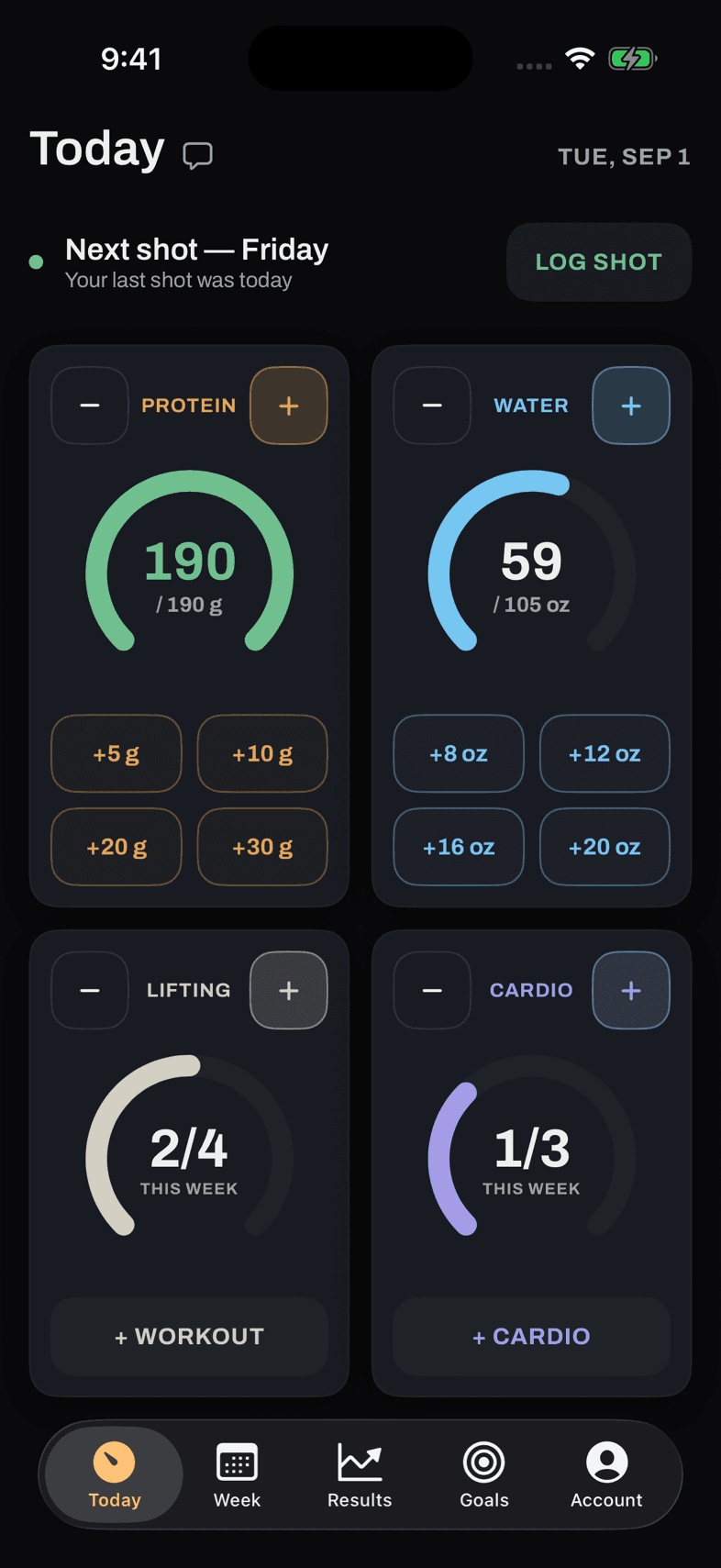
Track Protein in 1-Tap.
Consuming 140–180g of protein a day is very hard. Bild Health makes it easy to track how much you consumed each day with simple 1 tap logging for protein, hydration, and exercises. You can also track from your Apple Watch. Start with the free protein calculator.
Track Weight and Muscle
Bild Health integrates with smart scales to help you track not just your weight but your lean mass as well, track both together and adjust your exercise and protein intake based on your results. See what the split looks like with the muscle-loss calculator.
Import Your DEXA Scans
Smart scales are good, but the reference most of them are checked against for body fat and lean mass is the DEXA scan. Bild Health imports your scan results and adds these to your charts beside your scale readings, giving you more data on your fat loss progress. More on how the two compare in DEXA scans vs. smart scales.
MeAgain alternatives, answered
Does MeAgain track muscle mass?
No, and MeAgain says so plainly: its own muscle-loss page tells readers that it does not measure muscle mass, that body composition takes a clinical scan, and that muscle is measured in a clinic, not an app; what it measures is protein intake and activity. That candor is worth respecting. It is also exactly the gap Bild Health exists to close: the clinic's scan and a body-composition scale, in one record.
Is MeAgain free?
MeAgain is free to download, and the daily loop stays free. Premium covers photo food logging, Journey Cards, the Capybara widget and unlimited Capy chat. Its App Store listing shows a $69.99 purchase alongside other options; the SKUs there are named 'Unlimited', while meagain.com calls the tier Premium without publishing a price.
What does MeAgain do better than Bild Health?
Food capture, comfortably. MeAgain takes food by photo, voice, barcode, search and quick-add, which is the broadest capture surface in the GLP-1 category, and its quick-add flow is the lowest-friction protein logging we have seen anywhere. It also runs on iOS, Android and as an iMessage extension, and its dose-timing guidance is a genuinely novel idea rather than a reskin of a reminder.
If I switch, do I lose dose tracking?
No. Shots, pills and dose changes are dated in the record, beside the measured fat and lean lines. MeAgain pairs its dose log with food logging; Bild Health pairs its dose log with a composition measurement. Which pairing you want is the whole choice this page is about.
Is it reasonable to run both during a switch?
A sensible pairing, if food capture is why you came to MeAgain: keep its meal logging, and let the composition record live where it is measured. Just give exactly one app custody of the dose history: two competing shot logs is the one arrangement that ends in a reconciliation headache.
How often do I need to weigh in for the trend to mean anything?
Daily, under the same conditions: same time, same state, before food. That sounds like more work than a weekly weigh-in and is actually less, because a daily cadence draws a trend no single morning can own. On top of that, a scan every few months is enough to keep the impedance trend anchored to something measured.
Keep the logging habit. Add the muscle.
Bild Health keeps fat mass, lean mass, protein, training and your dose history in one record. The lean number is measured from your scale, anchored by imported DEXA scans.
Lose the fat. Keep the muscle.