The best GLP-1 tracker apps,
in each category
Best GLP-1 apps, by category
Protein and muscle
 Bild Health
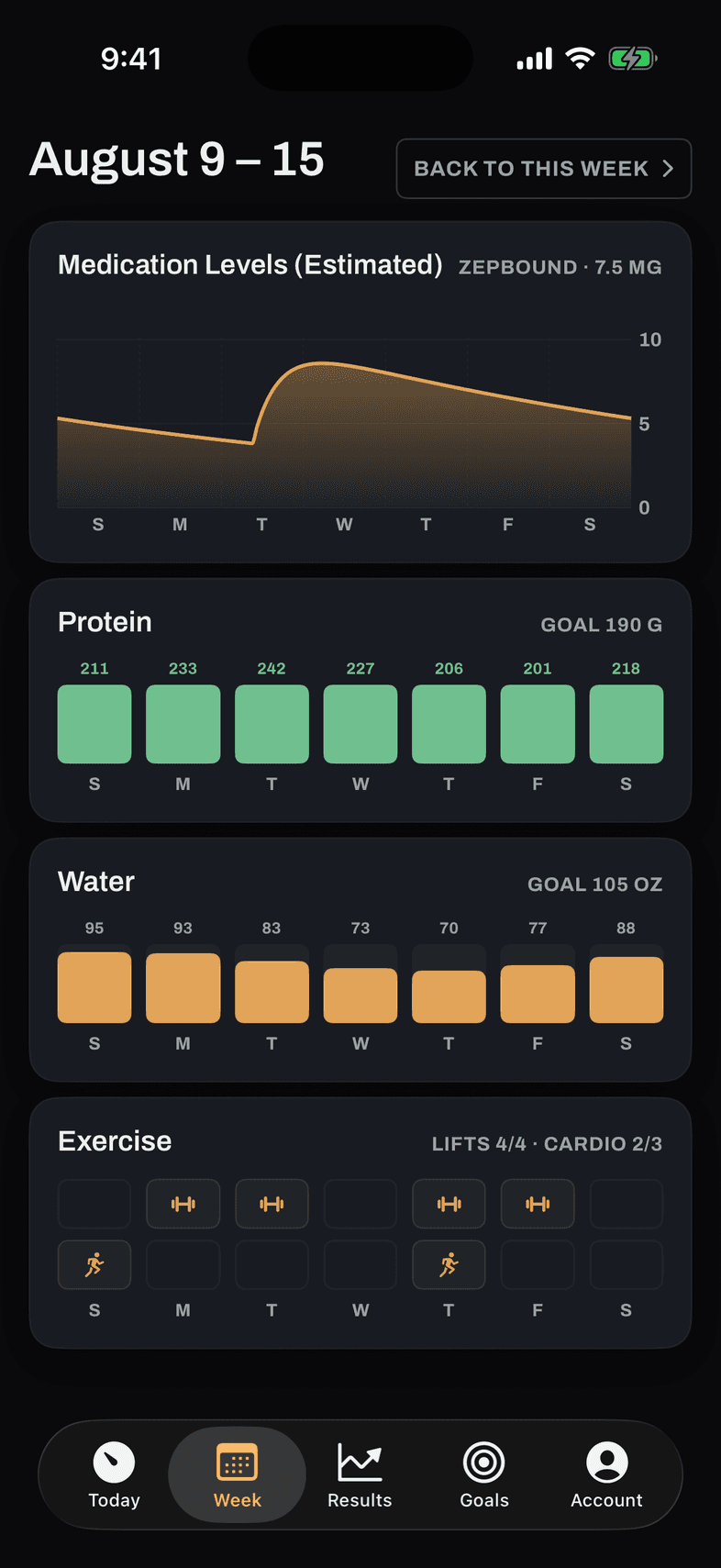
Fat and lean mass measured from a scale through Apple Health and Health Connect, anchored to imported DEXA scans, driving a protein target sized to fat-free mass.
Side effects
 Shotsy
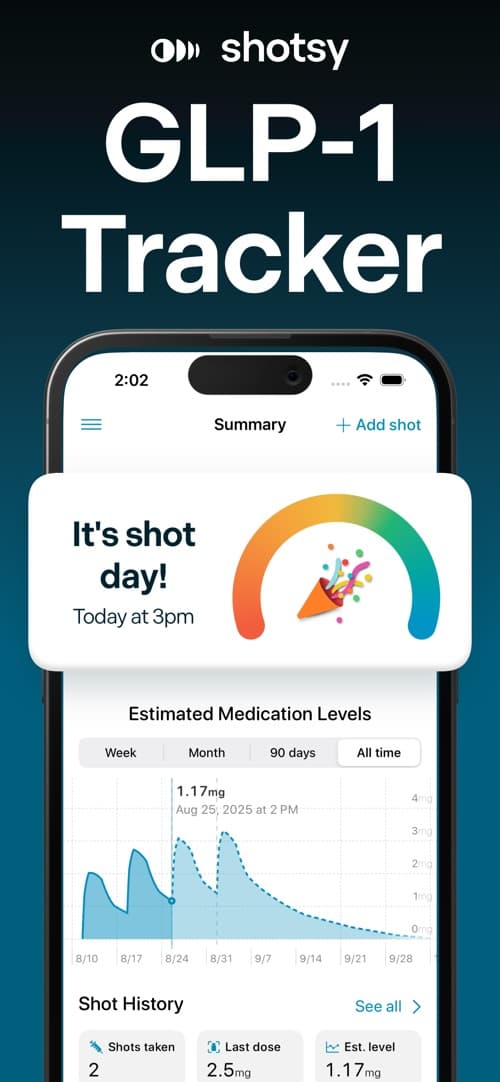
Side effects logged against the shot that caused them, read against an estimated medication level for four molecules, with titration planning and a PDF for your prescriber.
Calories and weight
 MyFitnessPal
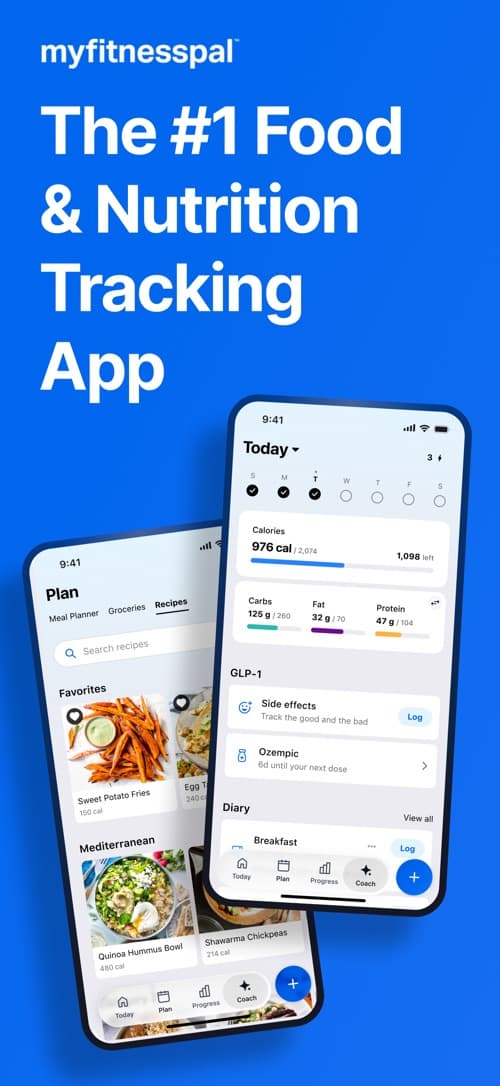
The original mainstream food tracker, on a 20M+ item library nothing here matches. Since 2026 the dose, the schedule and a side-effects card sit in the same diary.
Best GLP-1 app for tracking protein and muscle
The category the medication itself creates. A weight-only scale cannot tell a pound of fat from a pound of muscle, and 25–39% of that loss is lean mass, not fat. Three rows decide it: where the lean number comes from (a body-composition scale or a phone camera), whether it is charted as a line rather than stored as a field, and what the protein target divides by. Noom sits in the table below without a ranking of its own: its free GLP-1 Companion returns fat mass and lean mass in pounds from a 10-second phone video, which makes it the closest thing here to what we do, and the fairest test of whether where the number comes from actually matters.
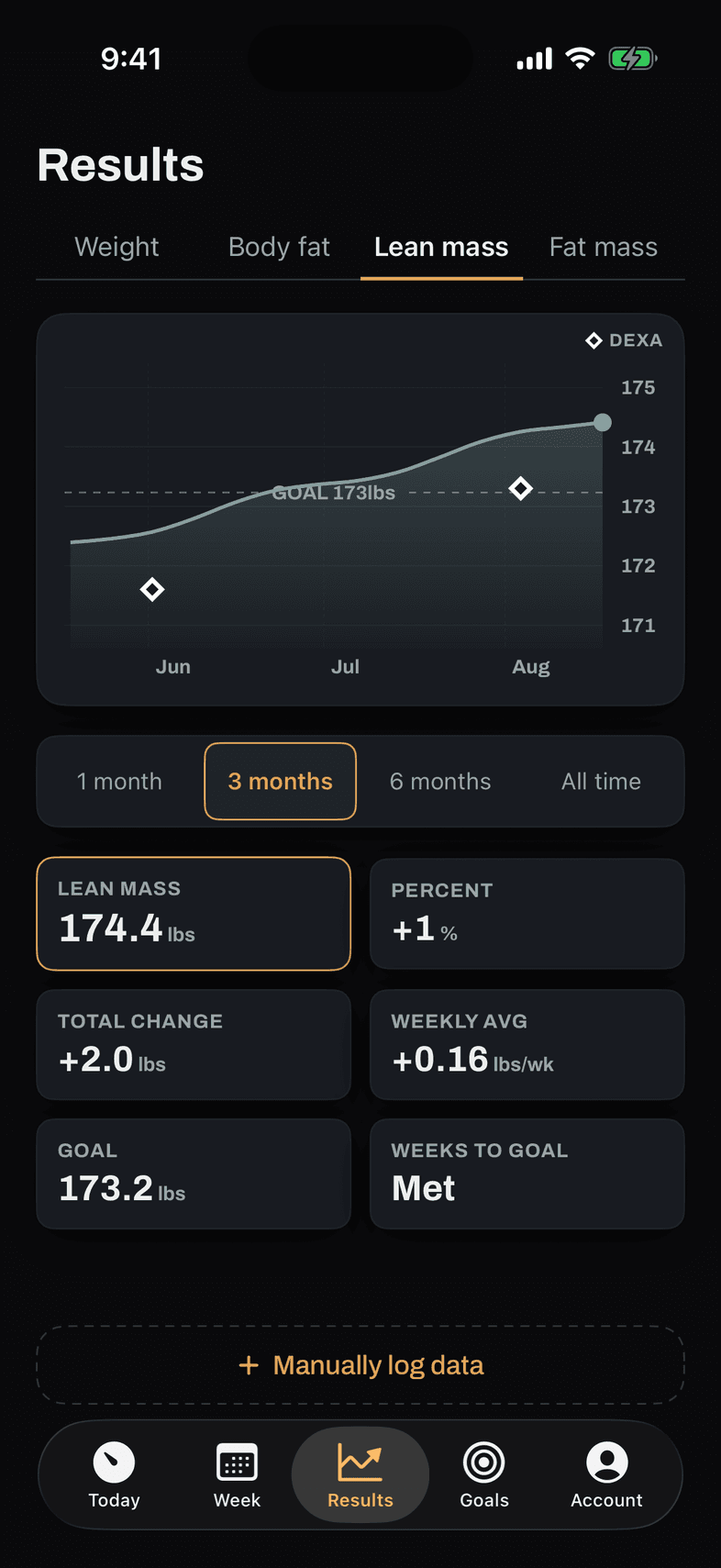
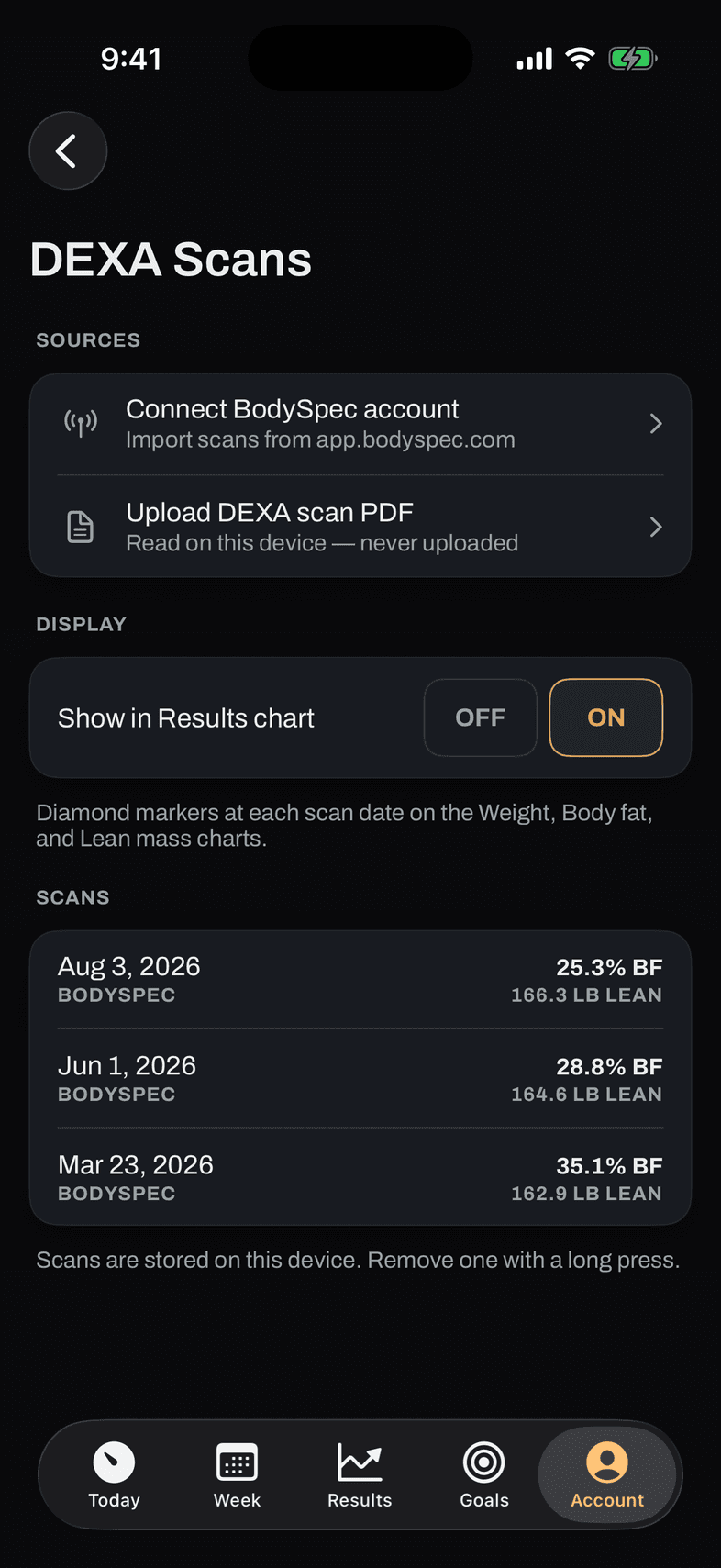
Bild Health offers a complete package for tracking muscle loss on a GLP-1 and doing everything you need to keep the muscle. It has shot logging similar to Shotsy, a deep smart-scale integration via Apple Health and Health Connect, and makes logging protein and water intake easy with all actions logged with 1 tap. This is also one of the few apps that make it easy to import a DEXA scan and add these metrics to your overall results. A key feature for recomposition is plotting the muscle mass and weight numbers in pounds so you can see when you are gaining muscle even when losing weight.

The only other app here that takes a lean-mass metric off a smart scale and charts it. Body Fat, Fat-free Mass and Skeletal Muscle Mass are default biometrics, syncing from Withings and Garmin scales and viewable over time in Trends. Under that sits the most nutritionally rigorous food database available: 84+ nutrients per entry, curated rather than crowdsourced. What it has none of is GLP-1 features. Cronometer’s own advice to people on a shot is to build a Gold Custom Biometric and log doses by hand.
| Bild Health | Cronometer | Noom | |
|---|---|---|---|
| Charts lean mass as a line over time | Yes | Yesfat-free mass, in Trends | Yeslean mass, in pounds |
| Fat mass and lean mass in pounds | Yes | Partialderivation not published | Yes |
| Body composition from a smart scale | Yes | YesWithings, Garmin | No10-second phone video |
| DEXA scans imported as checkpoints | Yes | Nomanual entry only | No |
| Lean mass measured from a scale and anchored to a scan | Yes | Partialscale yes, scans by hand | No |
| Protein target basis | 2.4 g/kg fat-free mass | lean mass, Keto Calculator only | personalized, basis unpublished |
| Price, a year | $59.99/yr | $59.99/yr | $209/yr |
Cronometer’s and Noom’s rows come from their own published pages and releases, read 31 July 2026. Prices are annual and, where a vendor lists several, the highest. Noom’s GLP-1 Companion and Cronometer’s Basic tier are both free, and both are covered under the toggle below with the scoring standards and the numbered sources.
Best GLP-1 app for tracking side effects
Nausea, reflux, constipation and fatigue are the reason people stop taking these drugs, and they are not random: they track the dose and the days since it. So this category is won on dose tracking done properly: recording what happened, how badly, and against which shot, reading it against where the medication level actually was, and handing the result to whoever writes the prescription. Bild Health is not in this table. A shot carries a free-text note, not a symptom taxonomy with a severity scale, and there is no titration guidance and no supply tracking.
The deepest medication model in the category, and the honest answer for anyone whose priority is the drug. Side effects log per shot, against estimated medication levels modelled on published clinical data for four molecules, with titration planning, injection-site rotation, multiple medications on separate schedules, and PDF export for a clinician. The drug list is the widest here: Rybelsus, Saxenda, Victoza, Trulicity, retatrutide, the Foundayo pill, Wegovy HD 7.2 mg. The full Shotsy comparison covers what its stored-but-not-charted lean-mass field means in practice.

The only app here that models the week rather than the dose: six named phases of the injection cycle, with food noise, hunger, cravings, mood, sleep and energy logged against where you are in it. Supply tracking with expiry dates, missed-dose guidance, and the only web client in this set. It deliberately does no macros, so how Glapp and Bild Health differ is mostly whether you track how you feel or what you are made of.

It wins on what the free tier holds, which is almost all of it. Free: dose logging for injections and pills, injection-site rotation, the “Perfect Dose Day” estimated medication level, side effects rated 0–10, food by voice, barcode, search and the fastest quick-add in the category, and protein, fiber and water goals tuned for people eating less. Premium adds exactly four things (photo food logging, Journey Cards, the Capybara widget and unlimited chat), and none of them is the medication log. The price below is what you pay to stop typing your dinner in, not what you pay to track your shots. A composition metric is in neither tier, and MeAgain’s own site says so.
| Shotsy | Glapp | MeAgain | |
|---|---|---|---|
| Side effects logged per dose | Yes | Yes | Yes0–10 severity |
| Food noise, hunger, mood and sleep tracked | No | Yesby cycle phase | No |
| Estimated medication level | YesShotsy+, 4 molecules | Yessema, tirzepatide | Yes |
| Titration planning and guidance | Yes | Yesplus missed-dose | Nodose timing only |
| Injection-site rotation | Yes | Yes | Yes |
| Supply and expiry tracking | No | Yesvials and pens | No |
| PDF export for a clinician | Yes | Noin-app reports | Noshare card |
| Free tier | Yesall but the levels | Yesboundary unpublished | Yesthe daily loop |
| Price, a year | $59.99/yr | $39.99/yr | $69.99/yr |
Vendor pages read 31 July 2026, with Shotsy and MeAgain re-read 24 August 2026. None of these three publishes a headline price, so each figure is the highest annual SKU on its App Store shelf; the toggle below names which, and what it hides.
Best GLP-1 app for tracking calories and weight
The oldest job here, and the one with real incumbents: the food database is the moat, and no GLP-1-native app has built one that competes. What changed in 2026 is that the old “you will need a second app for your shots” argument stopped being true. So this one is decided on capture friction, whether the target adapts, and whether the dose lives in the same diary. Bild Health is not in this table either: it logs protein and water against targets, with no food database, no barcode scanner and no calorie count at all.
The original mainstream food tracker, and still the one with the library everything else is measured against: 20M+ items, near-universal barcode coverage, the deepest restaurant and packaged-food catalogue anywhere, and the largest device-integration surface in this set.
In 2026 it shipped GLP-1 Support, which is what put it in this comparison at all. It logs the medication’s dose, time and injection location in the Diary next to the food, sets a medication schedule with reminder notifications, and adds a side-effects card to the Today screen where you pick a severity. It is US and English only for now. What it is not is a medication model: MyFitnessPal describes no titration schedule and no estimated medication level.
If the job is logging what you ate accurately and recording the shot beside it, MyFitnessPal wins and it is not close. Composition is the gap. By MyFitnessPal’s own documentation, body fat percentage is a custom measurement on the website and not the mobile apps, and there is no lean-mass metric at all.

The best-engineered nutrition app here. Its adaptive expenditure algorithm infers your actual maintenance from logged intake and weight trend, then updates your macros weekly. That dissolves the “my calories stopped working” plateau every static-target app creates, and it is exactly the plateau GLP-1 users hit. Protein comes from an estimated lean body mass rather than scale weight, derived from a body-fat category you select. No GLP-1 features of any kind, and no free tier: a 7-day trial, then a subscription.

The cheapest GLP-1-native option here, and the free tier is genuinely substantial: dose logging across fourteen medication options, the Estimated Levels chart, full nutrition logging, water and Apple Health sync. Meal capture by search, barcode, voice and recurring meals is polished, and the first-run experience is the most invested we have walked. The full Phaze comparison covers the gap between the marketing and the build.
| MyFitnessPal | MacroFactor | Phaze | |
|---|---|---|---|
| Food database with barcode scanning | Yes20M+ items | Yes1.36M verified | Yessearch and scan |
| Macros recalculated from your own expenditure | No | Yesweekly | No |
| GLP-1 dose logged with the food | YesUS, English only | Nono GLP-1 features | Yes14 medications |
| Estimated medication level | No | No | Yesin the free tier |
| Weight trend charted | Yes | Yes | Yes |
| Free tier | Yesfood logging | No7-day trial only | Yesdose, levels, nutrition |
| Price, a year | $99.99/yr | $71.99/yr | $34.99/yr |
MyFitnessPal’s and MacroFactor’s rows come from their own published pages, read 31 July 2026; Phaze’s come from installing the shipped app on 24 August 2026, a higher evidence tier than a vendor page and the reason its cells describe the build rather than the marketing. MyFitnessPal’s figure is Premium+, the higher of its two tiers.
Honorable mentions
Four apps that win no category above and are still the right answer to a narrow question. None is a consolation prize; each beats every winner on something.

WeightWatchers
Best if you want a person in the loop: workshops, 1:1 dietitians and, at MED+, a prescriber inside the same product, which no app here replicates.

Pep
Best if your medication is a pill: Pep shipped oral GLP-1 support in January 2026, ahead of the category, and has released nine times since.

Lose It!
Best if you are done with subscriptions: a 56M+ item database, and the only Premium Lifetime price in this set at roughly $50–60 once.

Cal AI
Best if the only thing stopping you logging is friction: point the camera at the plate and its depth sensor estimates the portion, faster than anything else here.
Two caveats worth naming. WeightWatchers reports percentages rather than pounds of fat and lean, and its published protein target is 1 g per kg of starting body weight, which never moves as your composition does. That is the one place our disagreement is sharp. And Cal AI has been owned by MyFitnessPal since December 2025, so two entries here are one company; it claims no GLP-1 feature and no body metric beyond weight and photos, which makes it a complement rather than a competitor.
Sources and disclaimers
How the tables are scored
A cross means the feature is absent from what that vendor publishes, not proof the app cannot do it. Two cells are first-hand checks of running apps rather than vendor statements, and they are the two most likely to be overtaken by a release: Shotsy’s body-fat and lean-mass fields, added in v3.2.0, were still not charted when we installed and looked on 31 July 2026, and we installed Phaze on 24 August 2026 and found neither the body composition nor the DEXA import its site markets.
Cronometer’s Custom Biometrics and Custom Charts are Gold features, though Body Fat, Fat-free Mass and Skeletal Muscle Mass are defaults; whether it derives fat and lean mass in pounds or only stores what the scale sends is undocumented, which is why that row is a partial. Noom’s scan-accuracy figure is a repeatability claim from the vendor of the scanning technology, not an accuracy claim against DEXA, and we publish no precision figure for impedance either. MyFitnessPal’s and Cronometer’s support hosts decline our fetcher, so the web-only body-fat measurement and the biometric list come from the search index’s rendering of those vendor pages.
How the prices are chosen
One number per app, always the annual one, and where a vendor lists several SKUs it is the highest, so nothing here quotes a teaser. Shotsy publishes no price at all; $59.99 is the higher of two yearly SKUs listed side by side on its App Store shelf, and $39.99 is the other. WeightWatchers is MED+, the tier that prescribes, at $25 for a first month then $74/mo; CORE is $12/mo and the GLP-1 program starts at CORE+ at $22/mo. Noom is Noom Weight on the 12-month plan, while its GLP-1 Companion is free. MeAgain names Premium at $69.99 on its listing and publishes no price on its own site. Cal AI and Pep publish no price list either; those are their highest listed SKUs, with periods unstated. Lose It! also sells a Premium Lifetime SKU at $49.99–$59.99, the only one-off price in this set. App Store subscription ladders are offer-dependent, so the offer you are shown may differ. Icons, store listings and package ids were re-pulled 2 September 2026. Trademarks belong to their owners and are used here only to identify the products.
Why these rows decide it, with the trials behind each one: The Science.
Checked August 24, 2026. Every claim about each app on this page comes from each app’s own published feature and pricing pages, read on that date. Products change; if something here has gone out of date, tell us and we’ll correct it.
- MeAgain (App Store)
- Shotsy (App Store)
- Pep (App Store)
- Glapp (App Store)
- Phaze (App Store)
- Noom pricing
- WeightWatchers plans
- MyFitnessPal Premium
- MacroFactor pricing
- Cronometer Gold
- Lose It! (App Store)
- Cal AI (App Store)
Where these numbers come from
- 01
Effect of Incretin-Based and Nonpharmacologic Weight Loss on Body Composition
Annals of Internal Medicine · 2026 · Batsis JA, Gavras A, Gross DC, et al. Ann Intern Med. 2026;179(7):996–1013. doi:10.7326/ANNALS-25-00478
- 02
Once-Weekly Semaglutide in Adults with Overweight or Obesity
New England Journal of Medicine · 2021 · Wilding JPH, et al. STEP 1. N Engl J Med. 2021;384(11):989–1002
- 03
The FASEB Journal · 2013 · Pasiakos SM, et al. FASEB J. 2013;27(9):3837–3847
- 04
International Journal of Sport Nutrition and Exercise Metabolism · 2014 · Helms ER, et al. Int J Sport Nutr Exerc Metab. 2014;24(2):127–138
- 05
Preserving Healthy Muscle during Weight Loss
Advances in Nutrition · 2017 · Cava E, Yeat NC, Mittendorfer B. Adv Nutr. 2017;8(3):511–519
- 06
Sarcopenia: revised European consensus on definition and diagnosis
Age and Ageing · 2019 · Cruz-Jentoft AJ, et al. EWGSOP2. Age Ageing. 2019;48(1):16–31
- 07
Diabetes, Obesity and Metabolism · 2026 · Eisa N, Barood O. Diabetes Obes Metab. 2026;28(6):4818–4827. doi:10.1111/dom.70666. PMID 41877354.
Up to 39% of the weight lost on a GLP-1 is lean mass, not fat.
There is a narrow path to losing weight and keeping or even gaining muscle. To do so you must lift heavy and consume a ridiculous amount of protein.
Track Protein in 1-Tap.
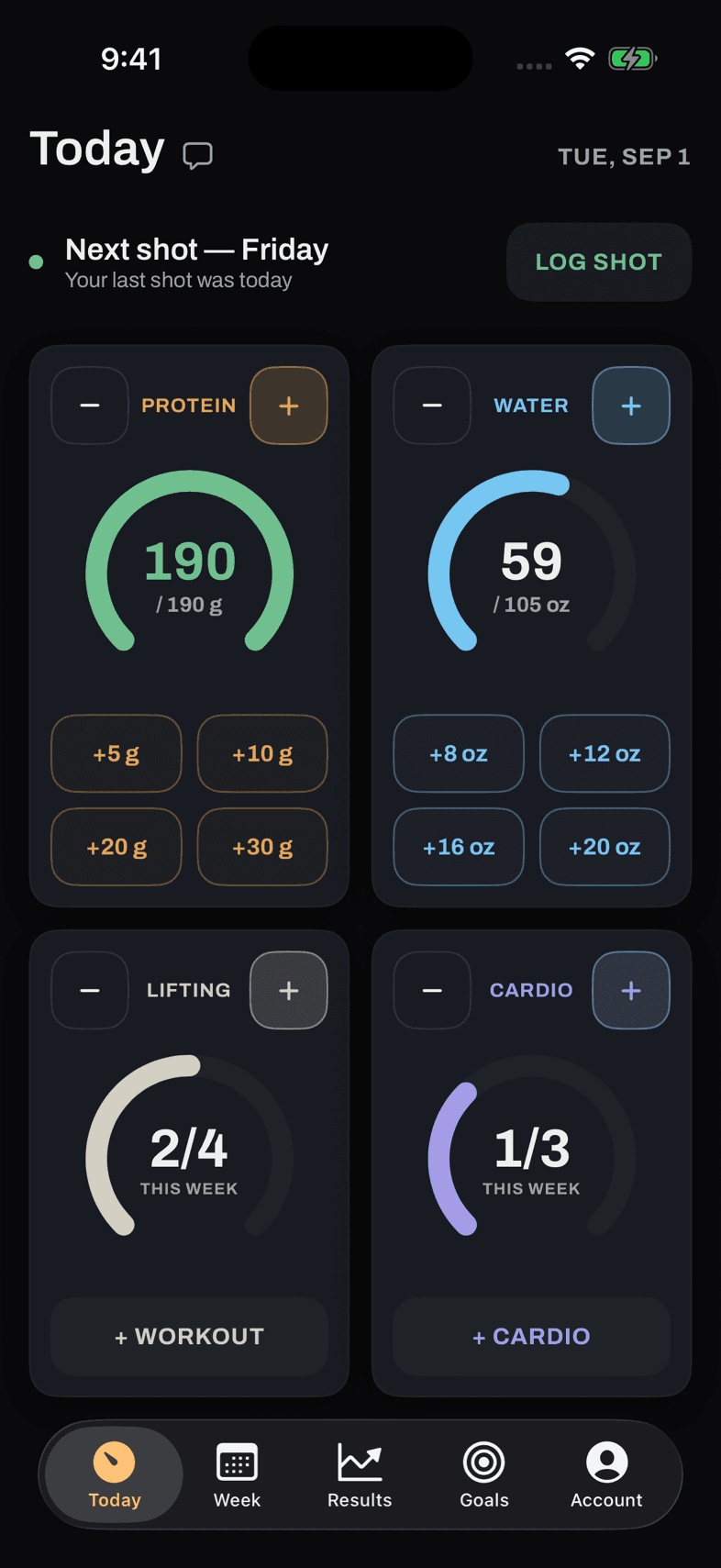
Consuming 140–180g of protein a day is very hard. Bild Health makes it easy to track how much you consumed each day with simple 1 tap logging for protein, hydration, and exercises. You can also track from your Apple Watch. Start with the free protein calculator.
Track Weight and Muscle
Bild Health integrates with smart scales to help you track not just your weight but your lean mass as well, track both together and adjust your exercise and protein intake based on your results. See what the split looks like with the muscle-loss calculator.
Import Your DEXA Scans
Smart scales are good, but the reference most of them are checked against for body fat and lean mass is the DEXA scan. Bild Health imports your scan results and adds these to your charts beside your scale readings, giving you more data on your fat loss progress. More on how the two compare in DEXA scans vs. smart scales.
The best GLP-1 tracker apps, answered
What is the best GLP-1 tracker app?
It depends which job you need done, which is why this page ranks three of them separately. For protein and muscle, Bild Health: fat and lean mass measured from a scale through Apple Health, anchored to imported DEXA scans, driving protein and water targets sized to fat-free mass. For side effects and the medication itself, Shotsy: per-shot side effects read against an estimated medication level, titration planning and a PDF for your prescriber. For calories and weight, MyFitnessPal, whose food database nothing here matches and which now logs doses too.
Is there a free GLP-1 tracker app?
Noom's GLP-1 Companion has been free since June 2026 and includes a medication tracker with side effects and reminders, personalized protein targets, muscle-preservation workouts and camera body scans. It is the strongest free tier here by a distance; Cronometer's free Basic tier has no GLP-1 features. The dedicated GLP-1 apps (Shotsy, Pep, MeAgain, Glapp, Phaze) are free to download with a paid tier on top. Phaze's free tier is substantial, and Shotsy's paywall covers exactly one thing: the medication-level chart. Glapp added paid Glapp Max in June 2026; write-ups calling it free predate that.
Which GLP-1 app tracks muscle loss?
The approaches differ in where the number comes from. Bild Health reads a body-composition scale through Apple Health and Health Connect, charts fat and lean mass in pounds, anchors the trend to imported DEXA scans, and puts dose, protein and lifting on the same timeline. Cronometer charts scale-fed fat-free mass and skeletal muscle mass, with no GLP-1 features alongside. Noom and WeightWatchers scan with the phone camera and claim no DEXA capability.
Which GLP-1 app is best for tracking side effects?
Shotsy, because it logs side effects against the shot that produced them and lets you read them against an estimated medication level modelled on published clinical data for four molecules, then export a PDF for your prescriber. Glapp is the runner-up and takes a different angle: six named phases of the injection cycle, with food noise, hunger, mood, sleep and energy logged against where you are in it. MeAgain is the value pick, with a 0–10 severity scale in a free daily loop. Noom, WeightWatchers and MyFitnessPal all log doses and side effects too, inside much larger programs.
Which GLP-1 trackers estimate medication levels?
Shotsy, MeAgain, Pep, Glapp and Phaze all publish some form of estimated medication level. Shotsy's is the most thoroughly described: levels modelled on published clinical data for four molecules, injections and pills, and it is the one thing Shotsy+ paywalls. Phaze's spans the widest picker, fourteen medication options, and sits in its free tier. Noom, WeightWatchers and MyFitnessPal log doses and side effects but claim no medication-level estimation.
Do I need a separate app for food and for my shots?
Less than you used to. MyFitnessPal shipped GLP-1 Support in 2026: dose, schedule and side effects in the Diary alongside food. MeAgain, Pep and Phaze combine dose logging with food capture from the start. What none of them pairs with a GLP-1 record is a measured fat-versus-lean split. Cronometer charts scale-fed composition, but with no dose history beside it.
How much do GLP-1 tracker apps cost?
Every price on this page is the annual one, and where a vendor lists several SKUs it is the highest. Bild Health is free to use, and Bild Health Pro, which adds DEXA import, the PDF health report and the AI protein estimator, is $59.99/yr with a 7-day free trial. The programs are the expensive end: $888/yr for WeightWatchers MED+, the tier that prescribes, and $209/yr for Noom Weight, while Noom's GLP-1 Companion costs nothing. The food apps sit in the middle: MyFitnessPal $99.99/yr, MacroFactor $71.99/yr, Cronometer Gold $59.99/yr. The indie GLP-1 apps run from Phaze at $34.99/yr to MeAgain at $69.99/yr, and most of them publish no price on their own site at all.
Which app sets a protein target, and how does it get the number?
The basis matters more than the number. Bild Health sizes protein at 2.4 g per kg of measured fat-free mass, recalculated as it moves. MacroFactor also uses lean mass, estimated from a body-fat category you pick. WeightWatchers uses 1 g per kg of starting body weight, which never moves; MyFitnessPal's guidance is 1.2–1.6 g per kg of body weight.
What should a GLP-1 tracker actually track?
Five things, in one record. The dose and the date, because titration is the variable that keeps changing. Side effects against the dose that produced them. Protein and lifting, because they are the two levers with real evidence behind them. And composition rather than weight alone: a weight-only scale cannot tell a pound of fat from a pound of muscle, and 25–39% of the weight lost across pooled DEXA and MRI trials was lean mass.
Can I use two of these together?
Plenty of people do, and the sensible pairing is a food logger plus a body-composition tracker. Cronometer or MyFitnessPal handles what you ate, against a database no GLP-1 app can match. Bild Health handles what your body did with it. Give exactly one of them custody of the dose history.
How current is this comparison?
Vendor pages were read on 31 July 2026, with Shotsy, MeAgain and Phaze re-checked on 24 August 2026, the Phaze check by installing the running app. Prices, icons and store listings were re-pulled on 2 September 2026. Three facts still stale in most write-ups elsewhere: Shotsy's paid tier covers only the medication-level chart; Glapp has had a paid tier since June 2026; and Phaze's marketed body-composition features were not findable in the installed app.
Track every muscle metric.
Bild Health keeps fat mass, lean mass, protein, training and your dose history in one record. The lean number is measured from your scale, anchored by imported DEXA scans.
Lose the fat. Keep the muscle.