Skip to content
Shotsy alternative

Shotsy takes your lean mass as a number. Bild Health charts it as a line.

Shotsy is the deepest GLP-1 dose tracking anyone has built. And it stores your lean mass as a number it never draws as a line. Bild Health charts fat mass and lean mass as two lines, in the same record as your dose history, so you can see whether the weight coming off is the weight you wanted to lose.

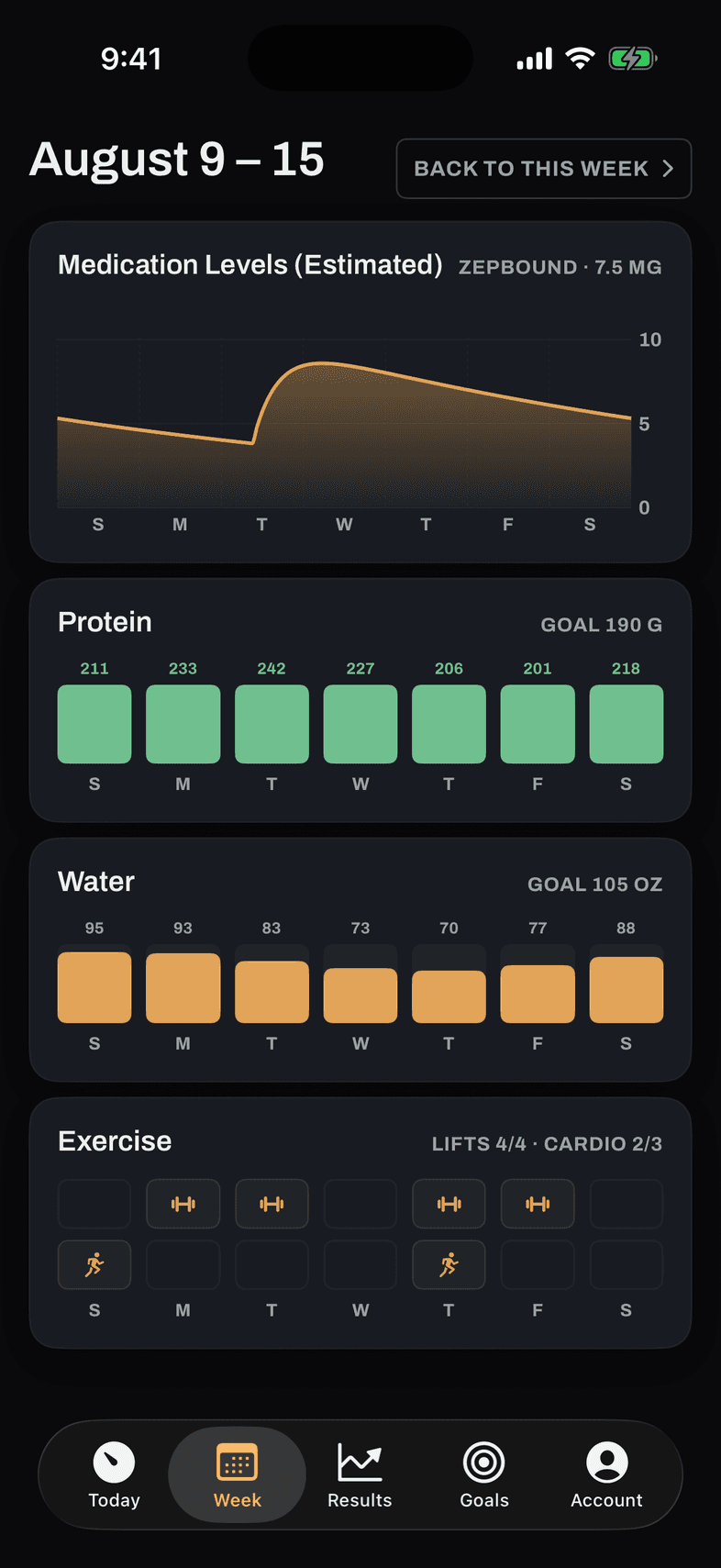
Bild Health Week screen: protein, water and training over the estimated medication-level curve
Medication levels, protein, water and lifting on one card: the week, on a single axis.

Updated August 24, 2026

IN SUMMARY

Shotsy is the best pure medication tracker in the category: the deepest estimated-levels model, titration planning, a 4.8 rating across thirty thousand US App Store ratings, and a free everyday loop. If the shot is the whole job, keep Shotsy.

The reason people look for a Shotsy alternative is the question it does not answer: whether the weight you are losing is fat or muscle. Shotsy added body-fat and lean-mass fields in April 2026, and we installed it and looked: there is no lean-mass trend to read them against. Bild Health is built on that measurement: fat and lean mass from a smart scale through Apple Health, DEXA scans imported as checkpoints, protein sized to fat-free mass, the dose history in the same record.

The strongest shot log in the category, and the line it doesn't draw

  1. 01

    Shotsy owns the medication

    Estimated levels modelled on published clinical data for semaglutide, tirzepatide, liraglutide and dulaglutide (injections and pills), titration planning, injection-site rotation, dosage stats, side effects, Maintenance Mode, PDF export for your clinician.

  2. 02

    Shotsy stores your lean mass and never charts it

    Since v3.2.0 the fields exist: values you can type in. There is no chart for them. The best medication logbook in the category records the shot in extraordinary detail and draws no line for the tissue underneath it.

  3. 03

    Bild Health does

    Fat mass and lean mass as two separate lines, in pounds, read from a body-composition scale through Apple Health and anchored to every DEXA scan you import. That is the whole difference.

  4. 04

    Everything against the dose

    The dose, body weight, fat mass, lean mass, protein and lifting share one record, so each step up the ladder arrives with a measured before and after attached to it.

Why the lean line is the one worth drawing

Three figures from the clinical literature, none of them about any app. They are the reason a GLP-1 record that stops at the shot leaves the interesting question open.

25–39%[source]
of weight lost is lean mass, before you add training

Pooled by medication in DEXA and MRI trials (each medication's trials pooled separately, never head-to-head): 25.4% across tirzepatide trials, 26.8% liraglutide, 35.2% semaglutide, and 17.5% once resistance training is added. That spread is the argument for measuring your own.

lean share with resistance training added

The lowest lean share any pooled group reported in a 2026 meta-analysis of 20 DEXA and MRI trials. It belonged to lifestyle plus resistance training, not to a drug. These are separate trials pooled separately, so read it as what that literature reports, not as a head-to-head result.

1.6 g/kg[source]
protein, in a 40% deficit

The twice-RDA arm of a controlled energy-restriction study preserved more fat-free mass than the reference intake, with no further benefit at three times RDA. Expressed per kilogram of total body weight, which is the denominator a measured lean-mass number lets you improve on.

What a charted body-composition series adds to an excellent shot log

Assume the medication record is already solved. With Shotsy it is. These are the four things that appear once the app also draws what the medication did.

Fat and lean, in pounds, on two lines

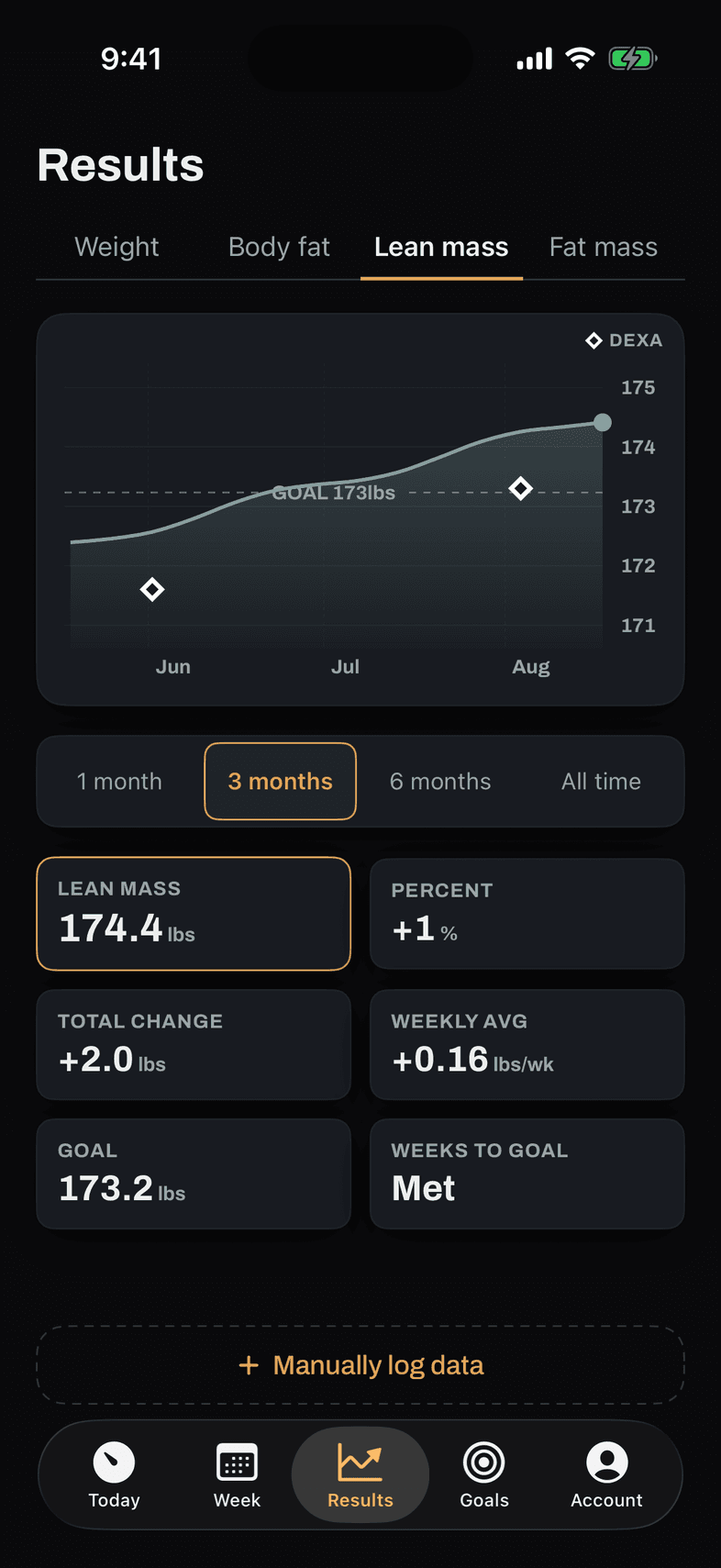
The lines are the product, not the fields behind them. A weight trend can fall for a good reason or a bad one and looks identical either way; two composition lines make the month legible while there is still time to change it.

  • Fat mass and lean mass held apart, never merged into one total
  • Body-fat percentage alongside the masses, not instead of them
  • Readings sync in from a compatible body-composition scale through Apple Health
Bild Health Results screen: fat mass falling toward goal
Bild Health Results screen: lean mass holding at goal
The fat line and the lean line, read separately — the same weeks, two different verdicts.

Every dose step with an outcome attached

A titration is a sequence of experiments you are running on yourself, and Shotsy records the inputs beautifully. This is what the same record becomes when the composition series runs underneath it: each step arrives with a measured before and after rather than a memory of how the month felt.

  • Injections and dose changes dated in the same record as the trend
  • The trend as a per-week rate on every Results tile — direction, not one morning's reading
  • The change in fat and lean across a step, rather than across a guess
Bild Health Week screen: protein, water and training over the estimated medication-level curve
Week — protein, water and training over the estimated medication-level curve

A protein target that knows its denominator

Published protein figures are written per kilogram of total body weight because body weight is what every trial participant could measure. Sizing a target to lean mass instead requires a lean-mass number that keeps updating, which is a body-composition feature wearing a nutrition feature's clothes.

  • Target computed against measured lean mass, not scale weight
  • Recalculated whenever the lean-mass reading moves
  • The one published per-fat-free-mass guideline is 2.3–3.1 g/kg, in lean trained athletes
Bild Health Goals screen: targets sized to lean mass
Targets sized to measured lean mass, and moved when it moves.

DEXA scans as the checkpoint

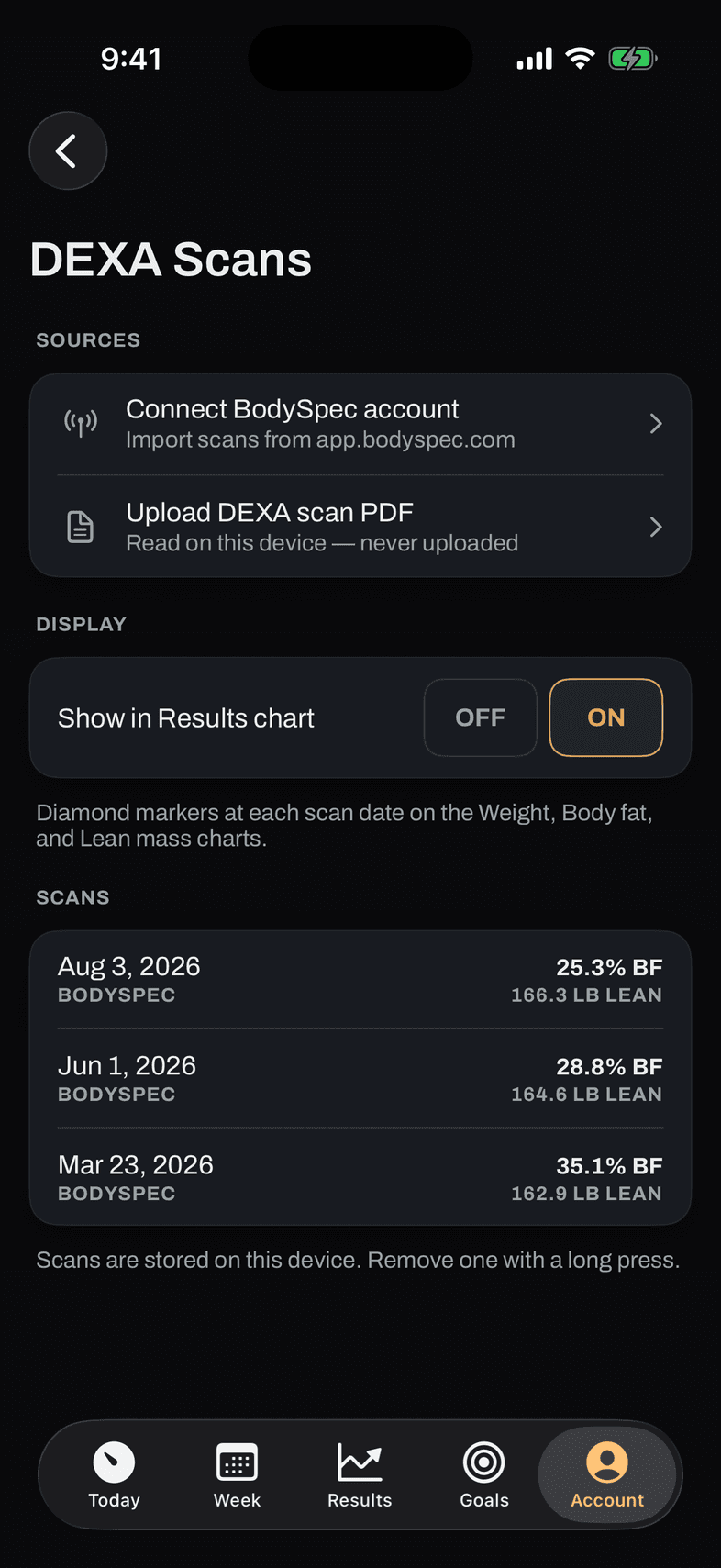
Impedance readings drift with hydration, food and time of day, so a daily series needs a fixed point to be read against. Connect a BodySpec account and every scan on it arrives by itself, plotted against the daily trend, with the gap between the two shown rather than quietly absorbed.

  • Scan values on the same axis as the daily readings
  • Fat mass, lean mass and body fat percentage imported with every scan
  • Scan markers land on the estimate's own chart, so drift is there to see
Bild Health DEXA Scans screen: scans imported from BodySpec, marked against the daily trend
Scans imported from BodySpec, marked on every chart.

The best logbook in the category, and the question it leaves open

Start with the compliment, because it is deserved and because this comparison is only worth making against something good. Shotsy has the deepest medication model in the GLP-1 category. It estimates how much drug is in you day by day, modelled on peer-reviewed clinical data, for semaglutide, tirzepatide, liraglutide and dulaglutide, across both injections and pills. It plans titration schedules. It rotates injection sites. It carries dosage stats, per-shot side effects, and multiple simultaneous medications on separate schedules. It covers a wider list of products than anything else in this set, including the newest ones. It exports a PDF you can hand to a clinician. It ships native Mac and Apple Vision builds alongside iPhone and Android, keeps your data on device with iCloud sync, and says plainly that it never sells it. If the job is “record the shot, completely,” Shotsy is the answer and this page is not trying to talk you out of it.

On 28 April 2026, in version 3.2.0, Shotsy went further. Its own release notes say: you can now track new metrics: body fat, lean body mass, waist circumference, and blood glucose. So the fields exist. Anything you read claiming Shotsy has no body-composition capability was written before that release and is wrong.

Feature by feature

Bild Health vs. Shotsy
Bild HealthShotsy
Logs every approved GLP-1, injection and pill
Yes
Yes
Estimated medication level, day by day
Yes
Yes
Titration planning
Partialladders, not a plan
Yes
Injection-site rotation
Yes
Yes
Side effects logged per shot
Partialfree-text note
Yes
Maintenance mode after goal weight
No
Yes
iPhone and Android apps
Yesat launch
Yes
Apple Watch quick-log app
Yesat launch
No
Tracks lean mass
Yes
Partialstored, not charted
Charts lean mass as a line over time
Yes
No
Tracks fat mass
Yes
Partialstored, not charted
Smart-scale readings through Apple Health
Yes
No
Imports DEXA scans as checkpoints
Yes
No
Sets a protein target from your lean mass
Yes
No

Shotsy’s rows come from its own published pages and release notes, read 31 July 2026. A cross means the feature is absent from what Shotsy publishes, not proof the app cannot do it. The exception is the body-composition rows: we installed Shotsy and looked, on that date. See the note at the foot of this page.

Two months a shot log cannot tell apart

A four-week dose step. The scale drops seven pounds.

The dose record is identical. The weight trend is the same straight line down. The side-effect log actually looks betterin the second one, because eating too little isn’t a symptom you report. No medication logbook, however good, can tell those two months apart. And by the time you feel the difference in what you can lift, it is months you cannot re-run.

The fix costs ten seconds. A body-composition scale takes the same weigh-in you already do, and the reading crosses into the app through Apple Health with nothing to type. Same habit, different output: a composition series instead of a weight one.

Where the two apps genuinely differ, stated carefully

Shotsy is not thin on body composition in the way the rest of the dedicated GLP-1 trackers are: it accepts body fat, lean body mass, waist circumference and blood glucose, which is more than any of its direct competitors claim. The difference is narrower and more specific than a feature count: it stores those numbers, and we could not find a lean-mass trend to read them against. Nothing in Shotsy’s published materials describes importing a DEXA scan as a checkpoint or syncing body composition from a smart scale, and its Apple Health section names weight, calories, protein and water. That is absence from the vendor’s own account rather than proof the app cannot do it, and it is how we would want our own product described.

The protein number, and what it is divided by

Shotsy describes protein as a value imported from Apple Health and displayed; nothing in its materials describes a target being set or personalized. That is a reasonable product decision for a medication logbook (protein is a nutrition problem, not a dosing one), but it leaves the main lever people have for holding onto muscle without a number attached to it. Ours is sized to fat-free mass: the free calculator shows the rule, and the plan it belongs to is the keep-the-muscle guide. Where Shotsy sits among all thirteen apps is in the full comparison.

What the evidence behind all this does and doesn’t cover

The lean-mass range and the training figure both come from one 2026 meta-analysis of 20 randomised DEXA and MRI trials, in which each group is a pool of different trials, so the groups are not a head-to-head comparison and should not be read as one. A separate 35-trial review adds the honest limit: no study reported objective physical-function outcomes, so these figures describe mass rather than what mass does. The protein figures come from controlled energy-restriction work in populations that were mostly younger, often trained and often male. No randomized trial has tested sleep, protein or training in people taking a GLP-1 specifically — the evidence comes from energy-deficit studies generally, which is exactly why measuring your own result matters.

What survives all of that is small and sturdy. The composition of the weight you lose is measurable, it varies a great deal between people, and it is the outcome the medication is being taken to produce. An app that records the shot perfectly and holds your lean mass as a stored value has solved the first half of that and left the second half unread.

Checked August 24, 2026. Every claim about Shotsy on this page comes from Shotsy’s own published feature and pricing pages, read on that date, with the one exception noted below. Products change; if something here has gone out of date, tell us and we’ll correct it.

Checked in the app, not on a page. The statement that Shotsy stores lean mass as a value and never draws it as a line (no lean-mass trend) comes from opening the app on 31 July 2026 and looking, not from anything Shotsy published. Shotsy ships frequently: treat this as the most perishable line on the page, and tell us if the current version proves us wrong.

Where these numbers come from

  1. 01

    Effect of Incretin-Based and Nonpharmacologic Weight Loss on Body Composition

    Annals of Internal Medicine · 2026 · Batsis JA, Gavras A, Gross DC, et al. Ann Intern Med. 2026;179(7):996–1013. doi:10.7326/ANNALS-25-00478

  2. 02

    Lean Mass Changes With Incretin Therapy Versus Lifestyle Intervention: A Systematic Review and Meta-Analysis

    Diabetes, Obesity and Metabolism · 2026 · Eisa N, Barood O. Diabetes Obes Metab. 2026;28(6):4818–4827. doi:10.1111/dom.70666

  3. 03

    Effects of high-protein diets on fat-free mass and muscle protein synthesis following weight loss: a randomized controlled trial

    The FASEB Journal · 2013 · Pasiakos SM, et al. FASEB J. 2013;27(9):3837–3847

  4. 04

    A systematic review of dietary protein during caloric restriction in resistance trained lean athletes

    International Journal of Sport Nutrition and Exercise Metabolism · 2014 · Helms ER, et al. Int J Sport Nutr Exerc Metab. 2014;24(2):127–138

  5. 05

    Preserving Healthy Muscle during Weight Loss

    Advances in Nutrition · 2017 · Cava E, Yeat NC, Mittendorfer B. Adv Nutr. 2017;8(3):511–519

Shotsy alternatives, answered

Is Shotsy free?

Mostly. Its own free-tier page says the everyday loop stays free, and the paid Shotsy+ subscription covers one thing: the estimated medication-level chart, the feature the app is best known for. Shotsy publishes no price; the App Store lists monthly SKUs from $9.99 and two yearly SKUs, $39.99 and $59.99, side by side, which reads as live price testing. What you are offered is best checked in the app.

Does Shotsy set a protein target?

Not that Shotsy describes. Its materials present protein as a number imported from Apple Health and displayed alongside the rest of your record; nothing in them describes a target being set, personalized or coached. That is absence from the vendor's own account rather than proof of absence. Bild Health computes a protein target against your measured lean mass and moves it as that number moves, which is a different job from showing you what you ate.

Does Shotsy track body fat and lean mass?

Since version 3.2.0 (April 2026) the fields exist: values you can enter. What we could not find in the running app on 31 July 2026 is a lean-mass trend: the value is stored, never drawn as a line. That line is the whole reason Bild Health exists.

Does Shotsy sync with a smart scale or import DEXA scans?

Nothing Shotsy publishes describes either: its Apple Health section names weight, calories, protein and water. That is absence from the vendor's account, not proof the app cannot. Bild Health reads fat and lean from a body-composition scale through Apple Health, anchored by imported DEXA scans.

Can I use Shotsy and Bild Health at the same time?

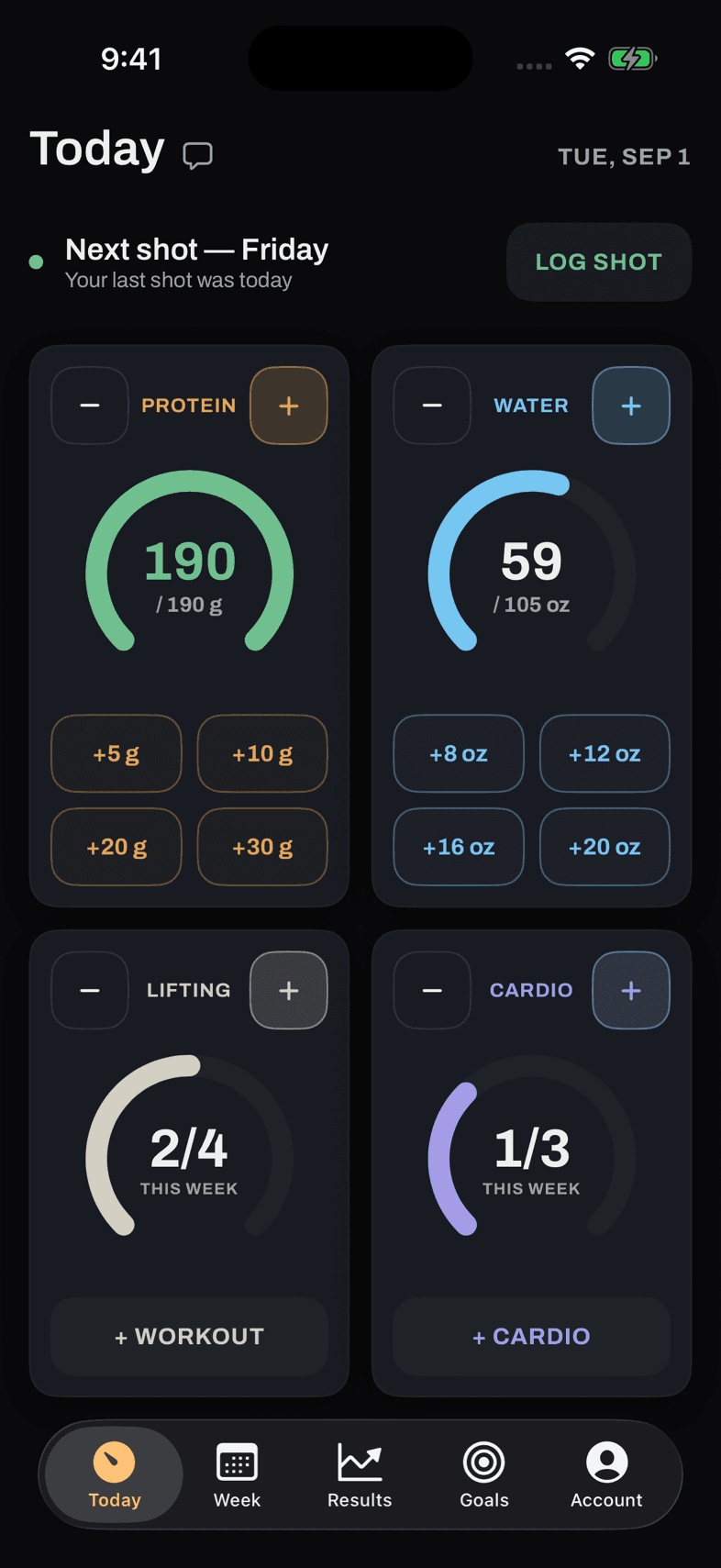
Plenty of people will: keep the deep medication logbook where it is deepest, and the composition record where it is measured. Bild Health logs doses, food and protein as well, so it also works as the only app on the phone. The only thing worth avoiding is keeping two authoritative dose histories, since reconciling them later is miserable — pick one app as the record of the shot.

Keep the shot log. Add the line underneath it.

Bild Health keeps fat mass, lean mass, protein, training and your dose history in one record — the lean number measured from your scale, anchored by imported DEXA scans.

Lose the fat. Keep the muscle.