GLP-1 muscle loss, through menopause:
keep the strength that carries you
IN SUMMARY
On a GLP-1 through menopause, a weight-only scale is the wrong instrument twice over. Across DEXA and MRI trials, 25–39% of the weight lost was lean mass, not fat. And a single weight cannot tell you which end of that range you are on. Menopause hides its own version of the same problem: through the transition, the rate of fat gain doubles and lean mass starts to fall, while total weight climbs at the same steady pace as before. The number stays polite. The composition underneath does not.
The answer is to measure what one weight merges. Bild Health charts fat mass and lean mass as two separate lines, anchored by every DEXA scan you import, with protein sized to your measured fat-free mass: 2.4 g per kilogram in a deficit, never below 60 g a day. And one practical fact this category skips: the scan that reads your body composition runs on the machine built to measure bone density. Keep every report. Your third scan can answer questions your first one couldn't.
What's different for women, briefly
- 01
One weight hides the transition
Through menopause, fat gain speeds up and lean mass falls, and the two roughly cancel, so weight shows no jump. One number, two opposite stories. Charting them apart is the fix.
- 02
The floor is 60 grams
Bariatric medicine's absolute protein floor for appetite-limited patients: the engine never sizes a woman's target below it, however small the formula's answer gets.
- 03
Bone rides on the same scan
DEXA is the bone-density machine; body composition is its second job. A whole-body report often carries a bone line: keep it, and bring the question to your clinician.
- 04
Strength is carrying capacity
A toddler on a hip, groceries up the stairs, the floor and back up without a hand. The lean line is the number under all of it, which is why it deserves watching while the weight comes off.
Three numbers that set the stakes
From the trials that measured composition and bone, not just weight.
Across 20 randomized trials measured by DEXA or MRI, 25–39% of the weight lost on incretin drugs was lean tissue.
Lifestyle programs that included resistance training cut the lean share of weight lost to 17.5%, the strongest lever anywhere in the data.
In the one trial that measured bone through GLP-1 weight loss (a year of liraglutide), the exercise-plus-medication group's hip and spine bone density held. The medication alone lost more than exercise alone.
Menopause, GLP-1s, and the body one weight can't see
Start with what the transition does on its own. In the SWAN cohort (the long-running study of women crossing menopause, with body composition measured by DEXA), the rate of fat gain doubled at the start of the transition and lean mass began to decline, from roughly then until two years after the final period. Total weight showed no acceleration at the transition: the extra fat and the lost lean roughly cancel, so the scale hides the change while it is happening. These are the same years estrogen is falling, from perimenopause on. Medicine's name for the muscle side, at its clinical end, is sarcopenia: a diagnosis made in clinics, not a label to self-apply. A GLP-1 adds a large, reliable deficit on top of exactly those years. That is not a reason to avoid the medication. It is the reason the full keep-the-muscle playbook matters more here, not less.
| Constant | Value for women | What it does |
|---|---|---|
| Protein coefficient | 2.4 g/kg fat-free mass | Sizes the daily target in a deficit; eases to 2.0 approaching goal |
| Protein floor | 60 g/day | The bariatric absolute floor: the target never goes below it |
| Fat-mass floor | 15% of body weight | Goal targets are screened so a goal cannot imply going below it |
| FFMI screen | 15 kg/m² | A lean-mass index sanity check on goal plausibility |
| ALMI reference | 5.5 floor · 6.1 young-adult mean, kg/m² | Appendicular lean-mass context for reading a DEXA report |
Engine internals from the published methodology: what the software computes, not individual guidance. Goal questions that touch a medical condition belong with a clinician.
The bone question, with the one trial that measured it
Women in GLP-1 communities ask about bones constantly. Most versions of the question sound like “osteoporosis runs in my family; should I be doing something?” Here is what exists (the other bone trials are gathered on The Science). One randomized trial has measured bone density through GLP-1 weight loss: a year of liraglutide, exercise, both, or placebo, after a low-calorie diet. The combination group lost the most weight, and their hip and spine bone density held, unchanged versus placebo. The medication alone lost more bone density than exercise alone, despite similar weight loss. One drug, one year, one trial: read it as a direction, not a class-wide verdict. But the direction matches the muscle data: the loss is not mandatory, and movement is the lever.
Then the practical fact. The DEXA machine exists in medicine mostly to measure bone density: the body-composition scan you book for fat and lean numbers is its second job, and a whole-body report often carries a bone line. Bild Health reads the composition figures from your scan: fat mass, lean mass, body fat. It does not read or chart bone density: that line belongs to you and your clinician. So keep every report, and if bone is on your mind (family history, an osteopenia flag, a fracture that healed slowly), raise it at the appointment that ordered the scan. Arriving with reports beats arriving with worry.
Exercise, with the trials behind it
The same trial family answered the exercise question twice. The parent study found the exercise-plus-medication combination roughly doubled the drop in body-fat percentage versus either alone, with lean mass held: proof that moving changes what the loss is made of, even though its program was mostly cardio. For holding muscle specifically, resistance training carries the best evidence: in the pooled data, programs that included it cut the lean share of weight lost to 17.5%. Two or three lifting sessions a week that actually progress is the dose the evidence keeps pointing at. Women who lift into their seventies post their results like trophies. They are not wrong to.
What the strength is for
One honest gap: none of the trials above measured physical function. Worth remembering when headlines get loud. But ask women on these medications what they are protecting and the answers are concrete. Carrying a kid on one hip. Getting down on the floor with a toddler and back up without a hand. Groceries, stairs, steadiness on an icy morning. The lean line is the number underneath that list, and watching it hold while the fat line falls is what losing the right weight means. It is a chart, not a feeling. Start with the free protein calculator for the women's numbers, and which scale to trust, and when has its own honest answer.
The readout, sized for you
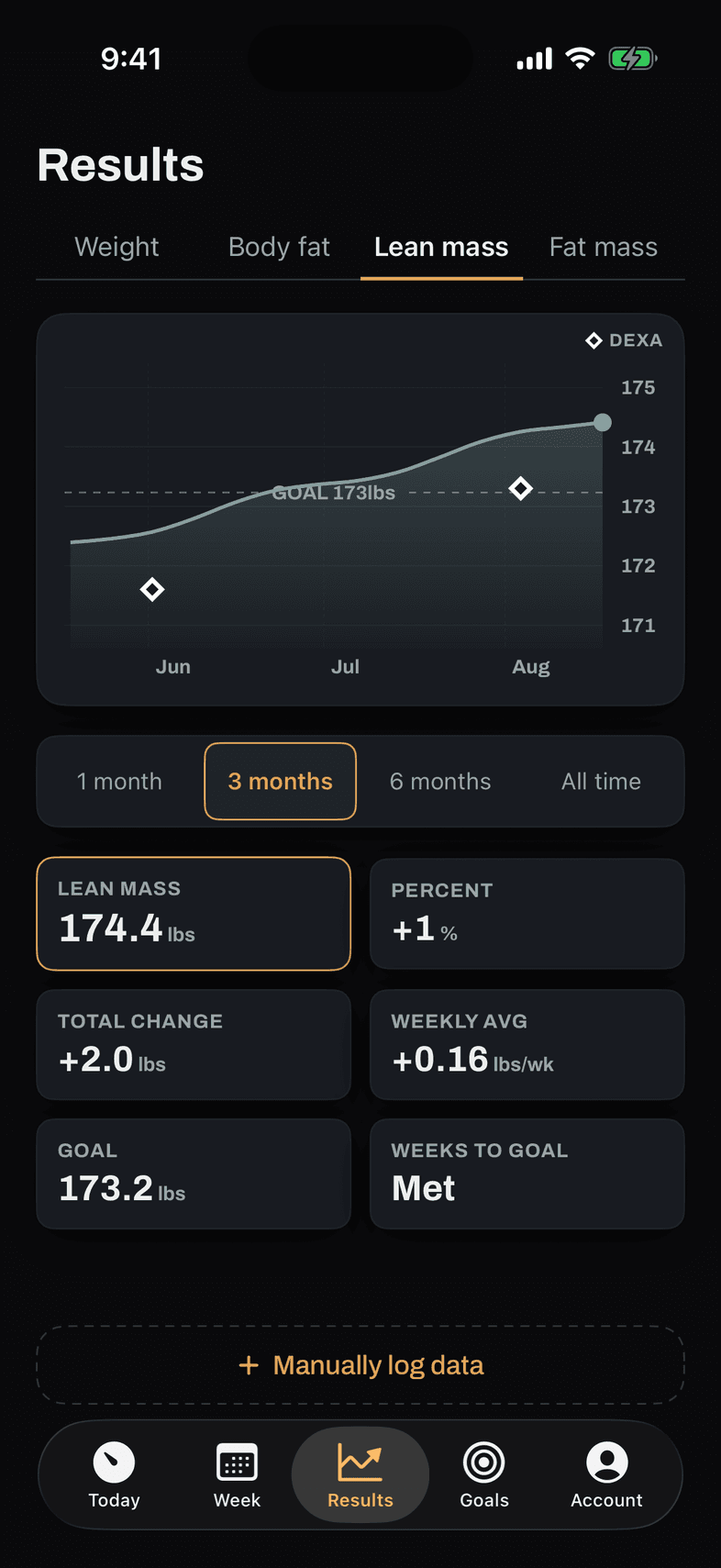
One screen carries the argument.
Two lines, not one number
Fat mass and lean mass held apart, anchored by every scan you import, with protein sized to your measured fat-free mass and the women's floor underneath it. The first scan starts the story; the ones after answer it.
- Fat mass and lean mass held apart, never merged into one total
- Readings sync in from a compatible body-composition scale through Apple Health and Health Connect, and from imported DEXA scans
- Connect a BodySpec account and every scan imports on its own (or upload a report PDF from any provider), and your protein target draws on the lean mass it reports.
Where these numbers come from
- 01
Diabetes, Obesity and Metabolism · 2026 · Eisa N, Barood O. Diabetes Obes Metab. 2026;28(6):4818–4827. doi:10.1111/dom.70666. PMID 41877354.
- 02
Changes in body composition and weight during the menopause transition
JCI Insight · 2019 · Greendale GA, Sternfeld B, Huang M, et al. JCI Insight. 2019;4(5):e124865. PMID 30843880. SWAN cohort, DEXA-measured.
- 03
JAMA Network Open · 2024 · Jensen SBK, Sørensen V, Sandsdal RM, et al. JAMA Netw Open. 2024;7(6):e2416775. PMID 38916894. Secondary analysis of the same S-LiTE RCT as lundgrenExercise.
- 04
Healthy Weight Loss Maintenance with Exercise, Liraglutide, or Both Combined
New England Journal of Medicine · 2021 · Lundgren JR et al. N Engl J Med. 2021;384(18):1719-1730. n=195, 1 year, post low-calorie diet.
- 05
Sarcopenia: revised European consensus on definition and diagnosis
Age and Ageing · 2019 · Cruz-Jentoft AJ, et al. EWGSOP2. Age Ageing. 2019;48(1):16–31
GLP-1 muscle loss for women, answered
Do women lose more muscle than men on GLP-1s?
The pooled trials report their numbers by drug, not by sex, so there is no good published split. What differs is the context. A woman starts with less lean mass, and the menopause transition is already pushing it down. The same loss lands on a smaller reserve, which is an argument for measuring, not for worrying.
Why does my weight look fine when my body feels different?
Because weight is fat and lean added together. Through the menopause transition, the rate of fat gain doubles while lean mass falls, and the two roughly cancel, so total weight shows no jump at all. A body-composition chart splits them back apart. That is the point of tracking two lines instead of one number.
Should I worry about bone density on a GLP-1?
In the one trial that measured bone through GLP-1 weight loss (a year of liraglutide), adding exercise kept hip and spine bone density unchanged, while the medication alone lost more than exercise alone. So take the question to your prescriber with data, not worry. The DEXA scan that reads your body composition runs on the machine built for bone density: keep every report, especially if osteoporosis runs in your family.
What should a woman's protein target be on a GLP-1?
Bild Health computes 2.4 g per kilogram of measured fat-free mass in a deficit, easing to 2.0 near goal, with a floor of 60 g a day for women, the same absolute floor bariatric medicine uses. Body-weight formulas drift as your weight falls. A fat-free-mass target stays attached to the muscle it protects.
How do I know if it's fat or muscle I'm losing?
Measure it. Don't guess. A body-composition scale (the kind that reads fat and lean, not just weight) gives you the weekly direction under consistent morning conditions, and a periodic DEXA scan anchors the level. Fat falling while lean holds means the plan is working. Both falling together is a chart worth showing your prescriber in week eight, not month six.
Related pages
- How to Keep MuscleOzempic Muscle Loss: How to Keep Muscle on a GLP-1
- DEXA vs. Smart ScaleAre Body Fat Scales Accurate? DEXA vs. Smart Scale
- Protein CalculatorProtein Calculator for GLP-1
- Water CalculatorHow Much Water Per Day on a GLP-1
- Muscle Loss CalculatorGLP-1 Muscle Loss Calculator
- The ScienceThe Science Behind Bild Health: Muscle, Fat, and GLP-1s
Measure the reserve you're protecting.
Bild Health keeps fat mass, lean mass, protein, training and your dose history in one record. The lean number is measured from your scale, anchored by imported DEXA scans.
Lose the fat. Keep the muscle.