Ozempic muscle loss,
and how to keep the muscle
- ProteinSTRONG
- Resistance trainingSTRONG
- Slower rate of lossMODERATE
- SleepPROMISING
- Most supplementsTHIN
Our reading of the literature cited on this page, not a formal grading. The top two are where the effort goes.
IN SUMMARY
Does Ozempic cause muscle loss? Losing weight quickly does, whatever produces the loss. And GLP-1 medications produce it reliably. Across DEXA and MRI trials, roughly 25–39% of the weight lost on semaglutide (Ozempic, Wegovy) or tirzepatide (Zepbound, Mounjaro) was lean mass rather than fat; a 35-study review puts the median at 28.3%.
First: most of what you lose is still fat, and small short trials find strength largely holds. Second: the share is movable. Lifestyle arms that added structured resistance training lost only 17.5% as lean, the lowest share of any arm, and training and protein are yours to control on the medication too.
The plan: protein sized to the tissue you are keeping: 2.4 g per kilogram of fat-free mass a day, not a body-weight formula. Two to three lifting sessions a week. And fat mass and lean mass measured separately, so you can see whether it is working. The rest of this page is that plan, in order of evidence.
What to do, and what each thing is worth
- 01
Put protein first, every day
The most-replicated dietary factor in keeping muscle through a deficit. Bild Health sizes the target at 2.4 g per kg of fat-free mass and tracks intake against it, not against intention.
- 02
Lift twice a week, minimum
The best-supported single intervention there is. Whole body, hard sets, load creeping up. Two sessions you actually do beats three you plan.
- 03
Watch the split, not the total
Fat mass and lean mass as two separate lines from your first dose. It is the only readout that tells you the plan is working before your next scan.
- 04
Protect your sleep before your supplements
In a small crossover trial, short sleep cut fat loss and raised lean-mass loss on the same diet. Beyond creatine, the supplement aisle has little to offer.
- 05
Take the rate question to your prescriber
Slower loss tracks with better lean-mass retention. That question belongs in your appointment, with a charted trend rather than a hunch.
- 06
Start this week, not after the next scan
The week-one setup takes an afternoon: a baseline, a protein number, two sessions, a body-composition scale used the same way each morning.
Ozempic muscle loss, in three numbers
Each one with the population it came from, because that is the part the listicles leave out.
The span across drug arms in a 20-trial meta-analysis (15,782 participants, DEXA or MRI): tirzepatide pooled at 25.4%, semaglutide at 35.2%. A span, not a ranking: no head-to-head has measured body composition.
Lifestyle arms that added a structured resistance-training programme: the lowest lean-mass share of any arm in the analysis, drug or lifestyle. The medication arms did not add one.
Sized to the tissue the target protects, easing to 2.0 at maintenance, never below 80 g for men or 60 g for women. It sits inside the 2.3–3.1 g/kg-of-fat-free-mass band the one lean-mass-denominator guideline recommends for energy-restricted lifters, a leaner population than ours, which is what the floors are for.
Where Bild Health fits in the plan
The levers are yours. Bild Health is the instrument that tells you whether pulling them changed anything.
A protein target that moves with your body
A gram figure from your starting weight is wrong by the time it matters. Bild Health sizes the target to lean mass and recalculates as it changes, tracking the tissue you are keeping, not the weight you are losing.
- Target recalculates as lean mass updates from your body-composition scale or a scan
- Daily intake charted against the target, not a number in a notes app
- Per-meal view: a day hit entirely at dinner is not the same day
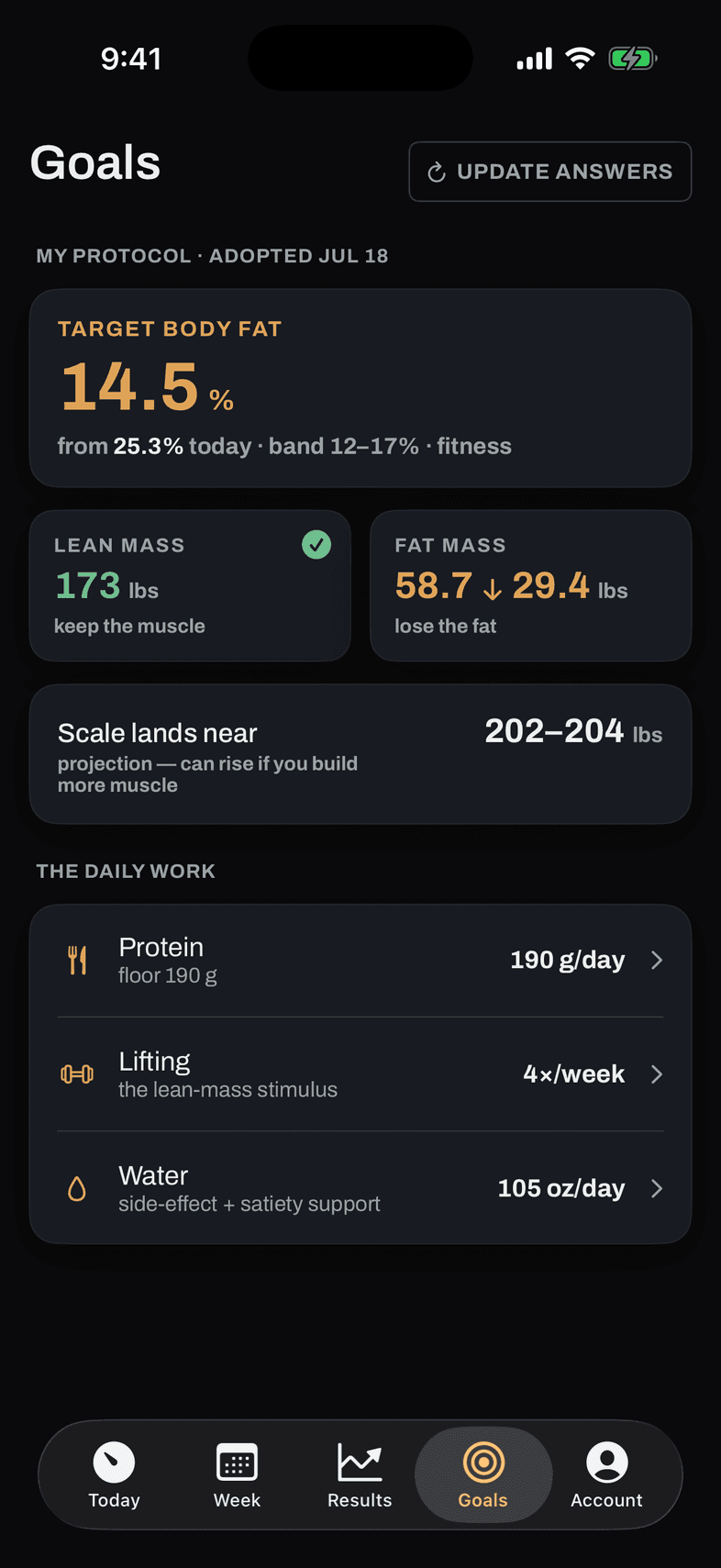
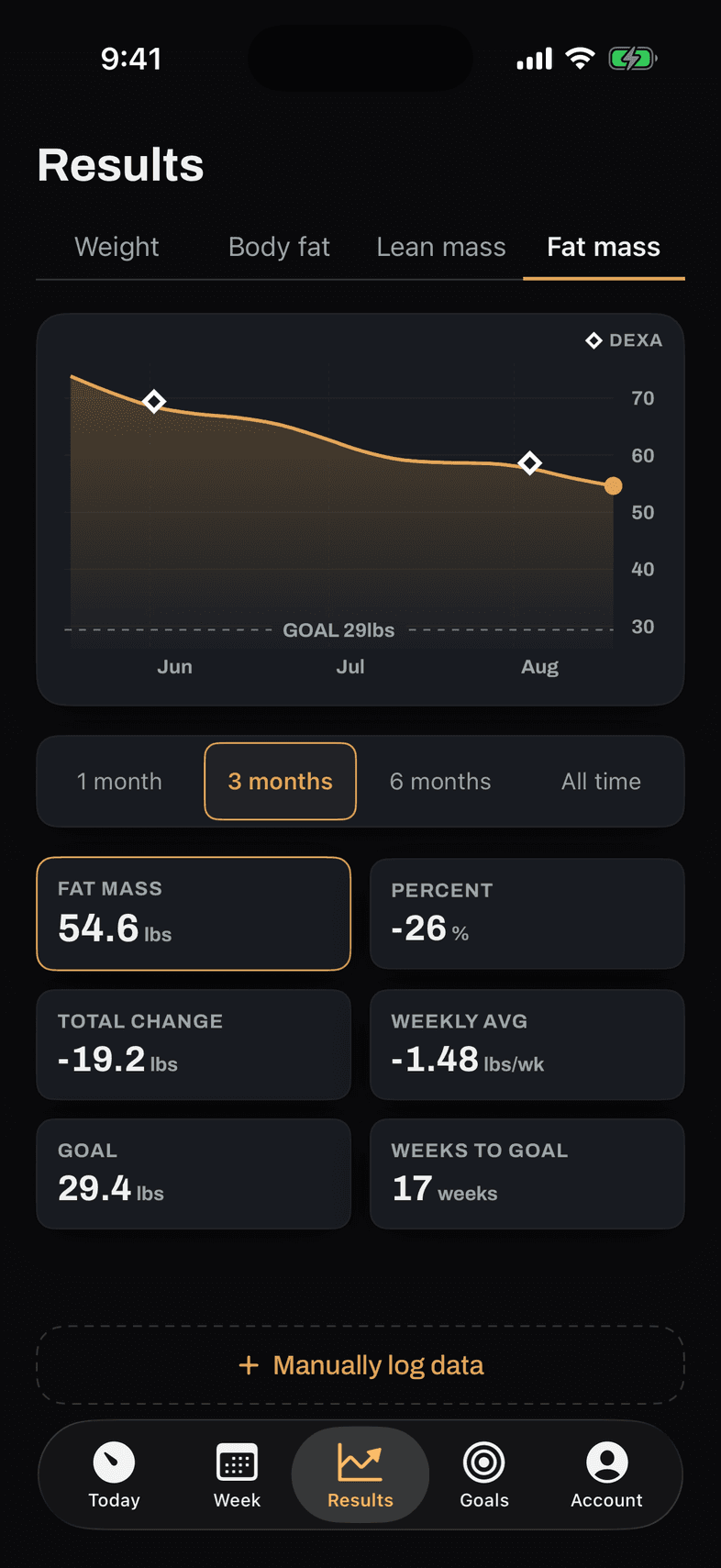
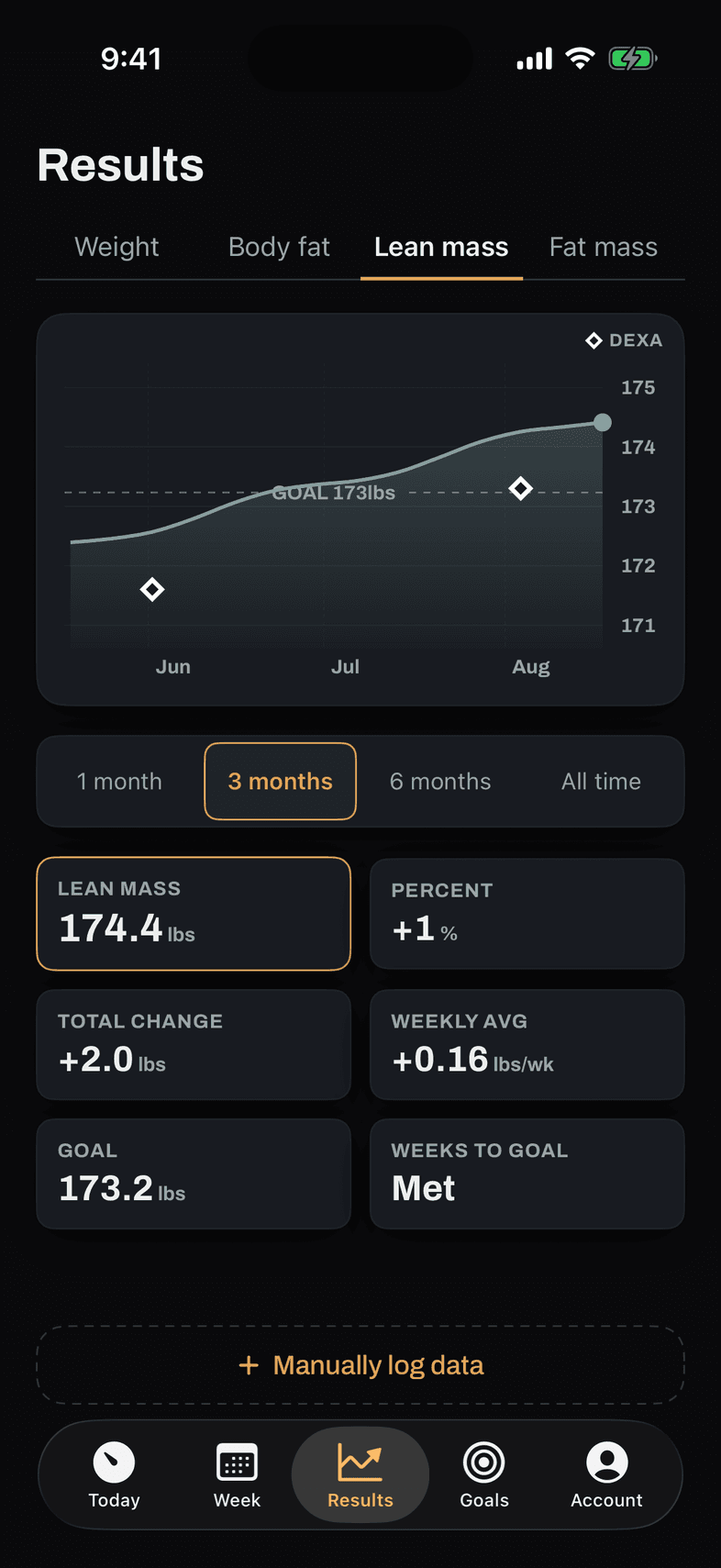
Fat mass and lean mass as separate lines
The payoff: if the fat line falls and the lean line holds, the plan is working. Visible in week six, not at your next scan. One weight number can never show this.
- Two lines from your first dose, not one weight trend
- The trend as a per-week rate on every Results tile: direction, not one morning's reading
- Readings sync in from a compatible body-composition scale through Apple Health and Health Connect, and from imported DEXA scans
The week you actually built
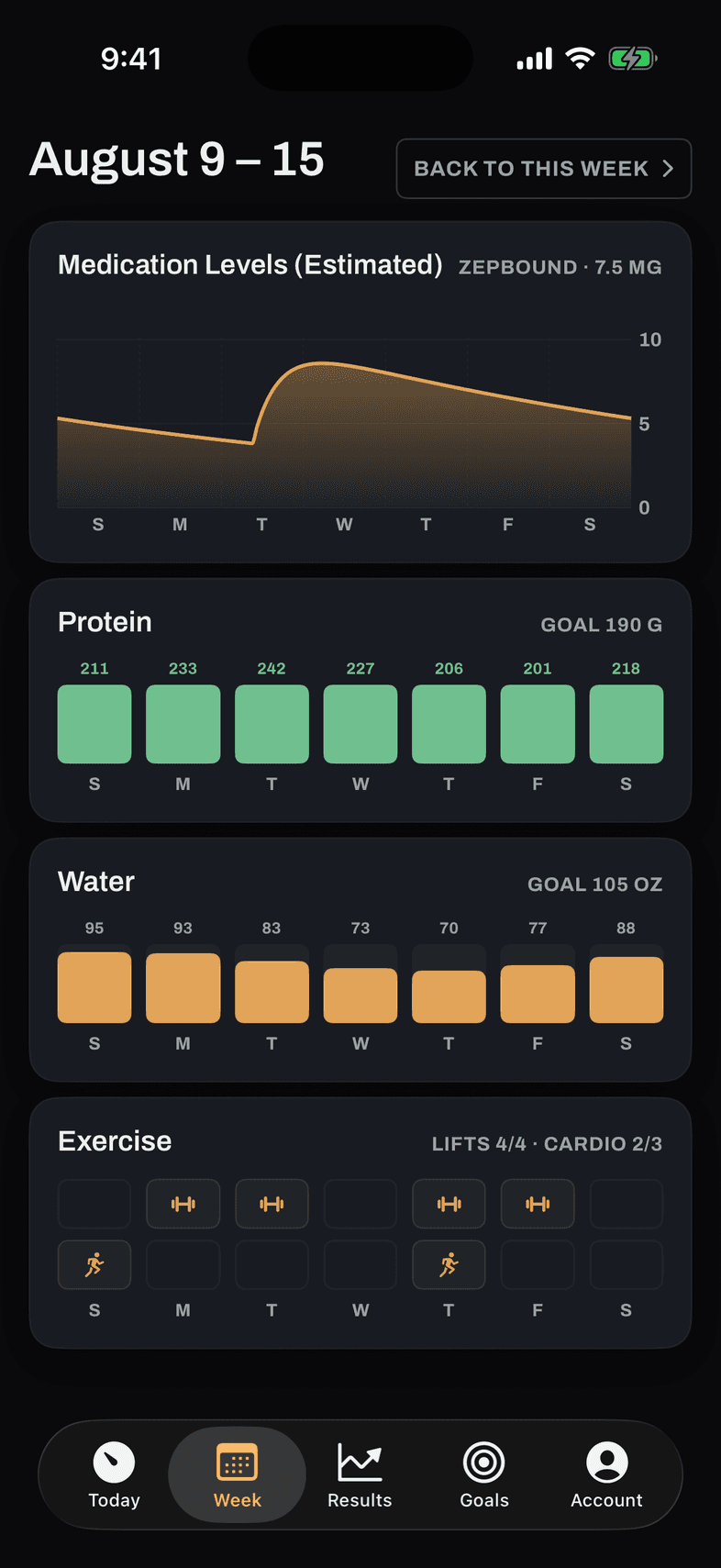
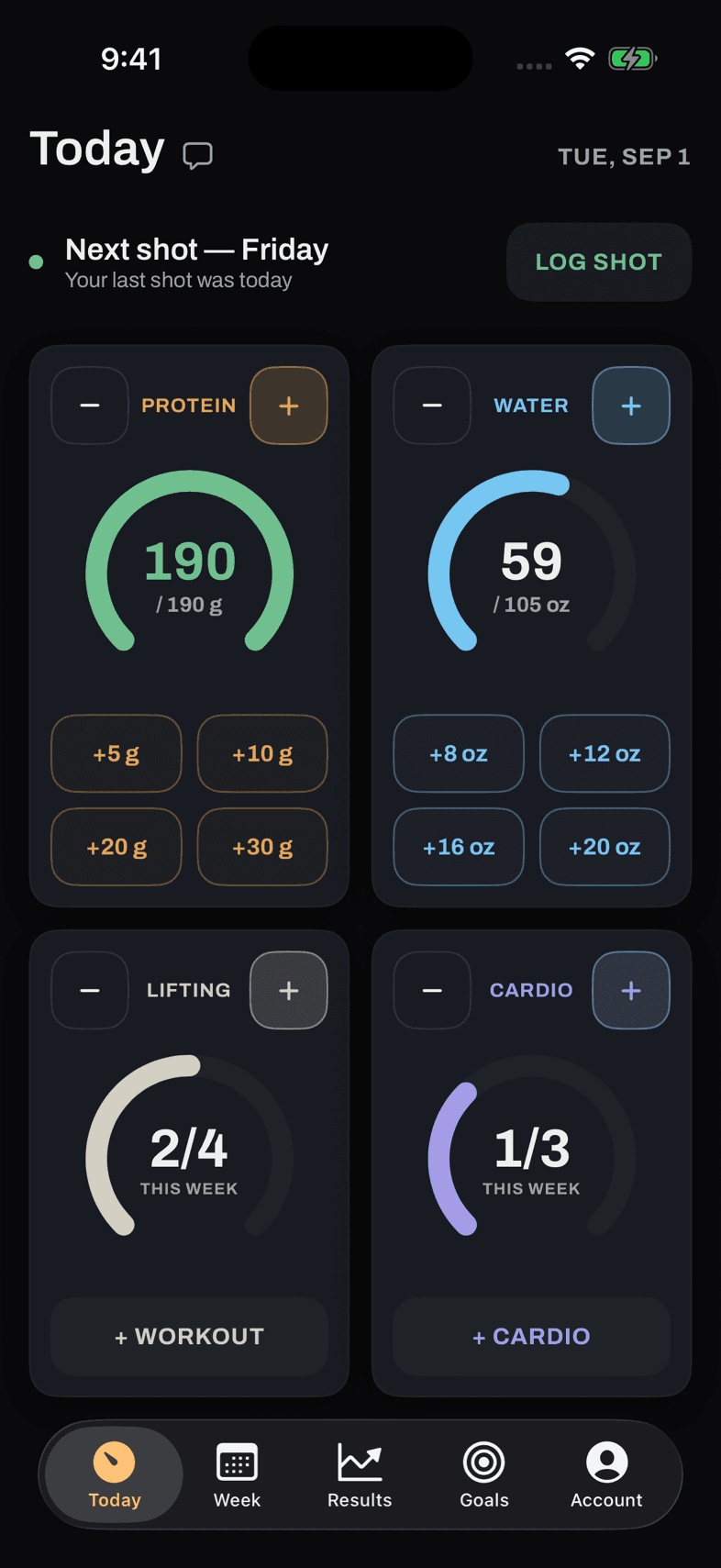
Protein, water, and training land on the same seven days as the estimated medication-level curve, so the question stops being whether you felt consistent and starts being what the week actually held.
- Protein and water, day by day against the goal
- Lifts and cardio logged on the week they belong to
- The estimated medication level for the same seven days, above the rest
Scans in, dose history beside them
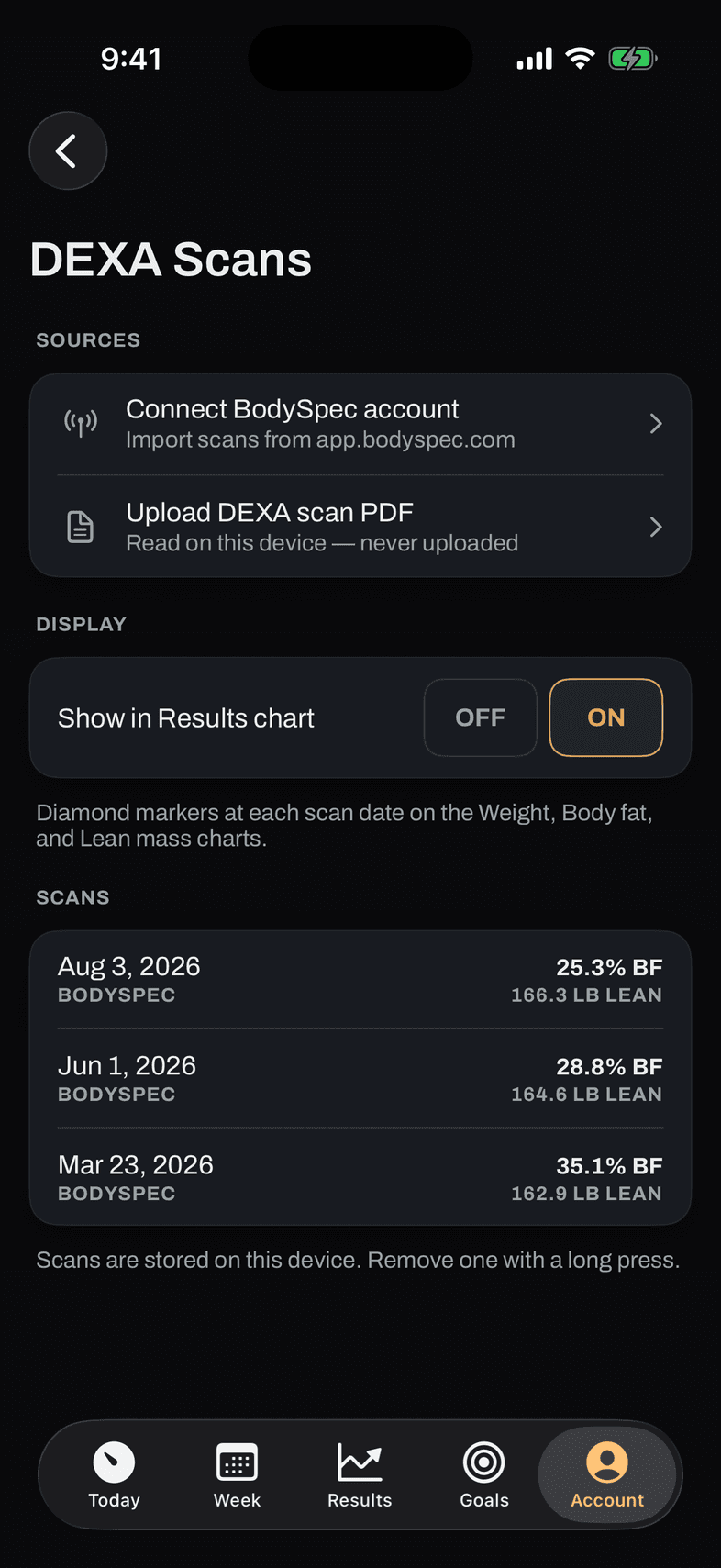
Connect a BodySpec account or upload a report PDF from any provider, and every DEXA scan lands on the same chart as your daily readings: the scale's drift from the reference, visible. Your dose history sits in the same record, which turns the next appointment into a data conversation.
- Scan fat mass, lean mass, and body fat percentage on the daily trend
- Scan markers on the same chart as the daily readings: one picture, not two apps
- Exportable, so the numbers go to the appointment with you
How much of Ozempic weight loss is muscle?
In a large energy deficit the body covers the shortfall from stored energy. Mostly fat, but not only. Muscle is expensive tissue, and a body reading a sustained shortfall keeps no more of it than the workload demands. That is ordinary physiology, documented in dieting and bariatric surgery long before these medications. What a GLP-1 adds is not a special mechanism of muscle loss but the reliability and size of the deficit.
| Source | What it found | The caveat that travels with it |
|---|---|---|
| 20-trial meta-analysis (DEXA/MRI, n=15,782) | Lean share of weight lost: tirzepatide 25.4%, liraglutide 26.8%, semaglutide 35.2%; lifestyle alone 26.2% | Between-study figures: a span, never a ranking |
| 35-study systematic review (2026, corrected) | Median share across the class: 28.3%, IQR 15.9–39.9% | No study in it reported objective physical-function outcomes |
| SURMOUNT-1 DEXA substudy (tirzepatide, 72 wk) | Of weight lost, approximately 75% fat and 25% lean | Placebo lost the same ratio, at a far smaller total loss |
| STEP 1 DEXA substudy (semaglutide, 68 wk) | Total lean mass fell 9.7% from baseline; lean proportion of body weight rose | Proportion rising while the absolute falls: both are true at once |
| Cell Reports Medicine 2026 (12-wk trial, n=10, type 2 diabetes) | Loss was 70% fat / 30% lean; quad size fell but strength held; lean-to-weight ratio rose | Small, short, at the 1 mg dose: its own authors call it inconclusive |
Lean mass on a DEXA report is not purely muscle: it includes organ tissue, connective tissue, and water, and some early decline is fluid. The trend matters more than any single reading.
Why act at all, if strength mostly holds in the short trials? Age. Muscle declines from the forties onward on its own, the process with the clinical name sarcopenia, so lean mass lost at 50 is rebuilt against a slower recovery than at 25. And the honest limit of the review above cuts both ways: no study in it reported functional outcomes. An argument for measuring, not assuming. The share is movable; the levers are below.
How to keep muscle on a GLP-1: the five levers
Five things decide how much muscle you keep, ranked here by evidence. A flat checklist where a supplement sits next to lifting is how most articles on this get written, and it costs you money and months. Two levers are worth most of your effort, one belongs to your prescriber, one is the readout, and one is sleep.
Lever 1: Protein, and the practical problem of hitting it
Start here: the lever with the most evidence and the most control. In the trial that tested it hardest, 39 adults held at a 40% energy deficit kept more fat-free mass eating double the reference protein intake than at the reference, and tripling it bought nothing extra. That protein matters is settled. The question most articles get wrong is what to divide by. The trials behind every lever on this page are laid out on The Science.
Body weight degrades as a denominator exactly as the intervention works, so Bild Health's Goal Engine sizes the target to fat-free mass instead: 2.4 g per kilogram of fat-free mass per day in a deficit, easing to 2.0 as you reach goal, never below 80 g for men or 60 g for women. A body-weight formula falls with the scale as you lose; the fat-free-mass number stays attached to the tissue it is meant to protect. Run your own number in the free protein calculator.
Target sized to lean mass, not scale weight, so it moves as your body composition does.
The part nobody writes about honestly: the barrier is not knowing the number. It is that the medication suppresses the appetite you would need to reach it, most aggressively in the days after a dose, and protein is the most satiating macronutrient: you fill up before you finish. A suppressed appetite does not feel like under-eating; it feels like being finished. Which is why protein has to be a tracked target rather than an intention.
In practice, in rough order of usefulness:
- Protein first on the plate, at every eating occasion: eat to appetite and add it at the end and you will not get there.
- Spread it: distributed protein stimulated muscle protein synthesis better than the same grams concentrated at dinner, and a suppressed morning appetite pushes toward the worse pattern.
- Density over volume: lean cuts, dairy, eggs, fish, legumes. Liquid protein keeps the target from collapsing in the 48 hours after a dose.
- Kidney disease or anything affecting protein handling: set the target with a clinician.
Lever 2: Resistance training, and what “enough” means
If you only add one thing, add this. Resistance training during a deficit is the best-supported way to hold fat-free mass. And unusually for this literature, it has been tested in people who look something like our reader. In a 160-person randomized trial of dieting adults aged 65 and over, the arms that lifted kept more lean mass than the arms that did cardio on the same diet. Older than the 40–60 range, but the right question asked of the right kind of body. And with the medication in the picture: in a one-year trial pairing liraglutide with exercise, the combination roughly doubled the drop in body-fat percentage versus either alone while preserving lean mass. That trial was aerobic-dominant, so read it as exercise changing what the loss is made of.
“Enough”: the trial protocol was three sessions a week; two hard whole-body sessions is a realistic floor that beats three planned and one performed. Legs and back hold most of your muscle and are the first thing skipped. And the load has to creep up: a workout that never gets harder stops being a reason to keep tissue.
Training changes the proportion rather than eliminating the loss, and it works alongside protein rather than instead of it. Expect sessions to feel harder than the load suggests, because energy availability on a GLP-1 is lower. Start conservatively rather than waiting until you feel ready.
Lever 3: Rate of loss, the lever most people ignore
Twenty-four elite athletes were assigned weight loss at 0.7% or 1.4% of body weight per week, both groups lifting; the faster group averaged 1.0% in practice. Lean mass rose 2.1% on the slower rate and was flat on the faster. Their intake was set by the study, not a medication. This is about energy deficits, not how fast any drug should work. Nothing on this page is a reason to skip a dose, delay a titration step, or change anything about a medication you were prescribed. That belongs to you and your prescriber. What is yours: the deficit you add on top (skipped meals, a big cardio block deepen what your prescriber already accounted for), and arriving at the appointment with a chart instead of a feeling.
Lever 4: Measurement, because the first three are unverifiable without it
Protein, training, and rate are inputs; none tells you whether it worked. A weight-only scale cannot close the loop: one number combining fat, muscle, bone, and water draws the same line through a good month and a bad one. The setup is two tiers and one discipline: a body-composition scale (the kind that runs a small current through you and estimates fat and lean, not just weight) for the trend, a DEXA scan every few months as the checkpoint, and consistency. Same time, same conditions, or you are measuring hydration and calling it body composition. How far to trust each instrument is its own question, answered honestly.
Lever 5: Sleep, and what is not worth your money
Sleep is the cheapest lever here. Ten overweight adults ate the same restricted diet for fourteen days at 8.5 versus 5.5 hours in bed: on short sleep they lost about 55% less fat and more fat-free mass. Striking rather than settled, and it costs nothing but an earlier bedtime.
Creatine sits in an honest middle: well-studied for training performance, safe record, no evidence in GLP-1 users specifically. As an adjunct to training, discussed with a clinician, defensible; as a substitute for protein or lifting, not. What we would not spend money on: BCAAs alongside adequate protein, testosterone blends, collagen for muscle, and the “muscle preservation” stacks now aimed at GLP-1 users. None has evidence comparable to the first two levers, and the two things that work are the two that take sustained effort.
| Day | Action | Why this order |
|---|---|---|
| Day 1 | Baseline: weight, a body-composition reading under fixed conditions, working loads on two or three main lifts | Nothing is evaluable without it |
| Day 1 | Calculate a protein target and write it down | A recitable target survives a low-appetite week |
| Days 2–3 | Restock around the target: dense protein sources, plus something liquid for the days after a dose | Post-dose days are when the plan fails, predictably |
| Days 2–7 | Two whole-body resistance sessions, conservative in load | Sustainable beats stopping in week three |
| Daily | Log protein per meal; weigh under the same conditions each morning | Only consistency makes noisy signals readable |
| End of week, and week 12 | Note questions for your prescriber; book a DEXA scan as the twelve-week checkpoint | Questions land better with data; the scan checks the scale |
What twelve weeks of this looks like
Working, on the Results chart: the fat line falls with your scale weight while the lean line moves far less. Some early decline is normal and includes fluid, so the target is a shallower slope, not a flat one. Not working: both lines falling together, loads sliding week over week, intake that looks fine in memory and thin in the log. That is a conversation to have with a prescriber in week eight with a chart, not in month six with a number.
Every lever here is an input. Bild Health is the readout.
Protein, training, rate, and sleep are things you do. None tells you whether it worked. That requires fat mass and lean mass as separate lines, the one thing a weight tracker structurally cannot show you.
- A weight trend, falling
- A generic protein goal from your starting weight
- Shot day, dose step, injection site
- A goal weight, with no idea what it's made of
- Fat mass and lean mass as separate lines from day one
- A protein target sized to lean mass, recalculated as it changes
- Weekly rate of loss with the fat and lean components split out
- DEXA scans imported from BodySpec or a report PDF, marked against the same trend
Where these numbers come from
- 01
Diabetes, Obesity and Metabolism · 2026 · Eisa N, Barood O. Diabetes Obes Metab. 2026;28(6):4818–4827. doi:10.1111/dom.70666. PMID 41877354.
- 02
Effect of Incretin-Based and Nonpharmacologic Weight Loss on Body Composition
Annals of Internal Medicine · 2026 · Batsis JA, Gavras A, Gross DC, et al. Ann Intern Med. 2026;179(7):996–1013. doi:10.7326/ANNALS-25-00478
- 03
Diabetes, Obesity and Metabolism · 2025 · Look M, Dunn JP, Kushner RF, et al. Diabetes Obes Metab. 2025;27(5):2720–2729. doi:10.1111/dom.16275
- 04
ENDO 2021 (abstract); parent trial N Engl J Med 2021;384:989-1002 · 2021 · Substudy n=140 (semaglutide 95 / placebo 45), DXA, 68 weeks, BMI ≤40. ENDO 2021 abstract (verified in full) with the parent trial at doi:10.1056/NEJMoa2032183; the URL is the trial registration, whose posted results a reader can actually open.
- 05
Cell Reports Medicine · 2026 · Langer HT et al. Cell Rep Med. 2026;7(3):102665. PMID 41850248. Open access, full PDF verified.
- 06
The FASEB Journal · 2013 · Pasiakos SM, et al. FASEB J. 2013;27(9):3837–3847
- 07
International Journal of Sport Nutrition and Exercise Metabolism · 2014 · Helms ER, et al. Int J Sport Nutr Exerc Metab. 2014;24(2):127–138
- 08
Dietary protein distribution positively influences 24-h muscle protein synthesis
The Journal of Nutrition · 2014 · Mamerow MM, et al. J Nutr. 2014;144(6):876–880
- 09
Aerobic or Resistance Exercise, or Both, in Dieting Obese Older Adults
New England Journal of Medicine · 2017 · Villareal DT, et al. N Engl J Med. 2017;376(20):1943–1955
- 10
Healthy Weight Loss Maintenance with Exercise, Liraglutide, or Both Combined
New England Journal of Medicine · 2021 · Lundgren JR et al. N Engl J Med. 2021;384(18):1719-1730. n=195, 1 year, post low-calorie diet.
- 11
International Journal of Sport Nutrition and Exercise Metabolism · 2011 · Garthe I, et al. Int J Sport Nutr Exerc Metab. 2011;21(2):97–104
- 12
Insufficient sleep undermines dietary efforts to reduce adiposity
Annals of Internal Medicine · 2010 · Nedeltcheva AV, et al. Ann Intern Med. 2010;153(7):435–441
- 13
Journal of the International Society of Sports Nutrition · 2017 · Kreider RB, et al. J Int Soc Sports Nutr. 2017;14:18
- 14
European Journal of Clinical Nutrition · 2011 · Hind K, Oldroyd B, Truscott JG. Eur J Clin Nutr. 2011;65:140–142. PMID 20842171.
- 15
British Journal of Nutrition · 2023 · Siedler MR et al. Br J Nutr. 2023;130(5):827–840. Full text: https://pmc.ncbi.nlm.nih.gov/articles/PMC10404482/
Keeping muscle on a GLP-1, answered
Does Ozempic cause muscle loss?
Rapid weight loss does, whatever causes it. And GLP-1s cause it reliably. In DEXA and MRI trials, 25–39% of weight lost was lean mass. Small short trials find strength largely holds, and protein plus lifting shrink the share substantially.
How much of the weight I lose will be muscle?
Across pooled trials: tirzepatide arms about 25%, semaglutide arms about 35%, class median 28.3%. The share was far lower in lifestyle arms that added structured resistance training. Your share is not fixed; the training and protein levers move it more than the choice of drug appears to.
What should my protein target be on a GLP-1?
Bild Health's Goal Engine sizes it at 2.4 g per kilogram of fat-free mass per day in a deficit, easing to 2.0 near goal, never below 80 g for men or 60 g for women. Formulas built on total body weight drift as the scale falls; a fat-free-mass basis stays attached to the tissue the target exists to protect.
How do I hit a protein target when I have no appetite?
Protein first on the plate: on a suppressed appetite there is no room later. Spread it across the day, choose dense sources, keep something liquid for post-dose days. And track it: intention and intake diverge quietly when you are not hungry.
How often do I need to lift to keep muscle?
The trial evidence in dieting older adults used three supervised sessions a week; two hard whole-body sessions is a realistic floor. What matters more than the count: the sessions stay hard and the load creeps up.
Do I need a DEXA scan, or is a smart scale enough?
Both: they do different jobs. DEXA is the reference method: the checkpoint, every few months. A body-composition smart scale is loose on any single reading but, under consistent conditions, reliable on direction. Scale for the trend, scan for the checkpoint.
Related pages
- For MenGLP-1 Muscle Loss in Men: Keeping Muscle After 40
- For WomenGLP-1 Muscle Loss in Women: Menopause, Muscle and Bone
- DEXA vs. Smart ScaleAre Body Fat Scales Accurate? DEXA vs. Smart Scale
- Protein CalculatorProtein Calculator for GLP-1
- Protein EstimatorProtein Estimator: Protein in a Meal From a Photo
- Best GLP-1 TrackersBest GLP-1 Tracker Apps
Do the work. Then check whether it worked.
Bild Health charts fat mass and lean mass separately from your first dose, sizes protein to the tissue you're protecting, and keeps it all in one record with your doses.
Lose the fat. Keep the muscle.