GLP-1 muscle loss, for men:
the thresholds are different
IN SUMMARY
Fast weight loss always takes some lean tissue with it: a quarter to a third of the loss, in pooled trials. A man loses it off a male baseline: more working tissue to feed, and a higher absolute protein need. Past 40 there is a third factor. Muscle you keep now is worth more than muscle you rebuild later, because rebuilding is slower than it used to be.
Bild Health's Goal Engine runs the male numbers. Protein at 2.4 g per kilogram of measured fat-free mass in a deficit, never below 80 g. Targets checked against male reference lines. And all of it charted: fat and lean as separate lines, DEXA checkpoints, the dose history in the same record. Whether you are keeping the muscle becomes a number you read, not a feeling you hope about.
The male numbers, briefly
- 01
The floor is 80 grams
The engine never sizes a man's protein target below 80 g a day, whatever the formula says. The clamp matters most late in a cut, when the per-kilogram rule is multiplying a smaller fat-free mass and the floor is what holds the line.
- 02
Strength is the fast signal
Lean-mass trends take weeks to read; working loads move faster. Holding strength while fat falls is the pattern that says the plan is working.
- 03
Age moves the stakes, not the math
The formulas are the same at 45 as at 25. What changes is recovery: muscle lost in this deficit is rebuilt more slowly than it was a decade ago.
- 04
Measured beats assumed
The trial shares are population averages. Your own split (fat versus lean, week over week) is the only number that describes you.
Two numbers with their populations attached
Both from the sources below. Both are averages, which is the point of measuring your own.
The range across drug arms in a 20-trial meta-analysis of DEXA and MRI studies. Trials differ too much for this to rank one drug against another.
From the randomized trial closest to this page's reader: dieting adults 65 and over. The lifting arms lost 2–3% of lean mass; the cardio arm lost 5%, on the same diet program.
Why the male thresholds differ, and what the engine does with them
Sex enters this problem twice. Men carry more fat-free mass at the same body weight, so the per-kilogram rule lands on a bigger target. And the reference lines the engine checks targets against sit at different values for men. These are the shipped constants, from the published methodology:
| Constant | Value for men | What it does |
|---|---|---|
| Protein coefficient | 2.4 g/kg fat-free mass | Sizes the daily target in a deficit; eases to 2.0 approaching goal |
| Protein floor | 80 g/day | The target never falls below this, whatever the formula returns |
| Fat-mass floor | 8% of body weight | Goal targets are screened so a goal cannot imply going below it |
| FFMI screen | 18 kg/m² | A lean-mass index sanity check on goal plausibility |
| ALMI reference | 7.0 floor · 8.6 young-adult mean, kg/m² | Appendicular lean-mass context for reading a DEXA report |
Engine internals from the published methodology: what the software computes, not individual guidance. Goal questions that touch a medical condition belong with a clinician.
The protein figures come from controlled energy-restriction work in populations that were mostly younger, often trained and often male.
The over-40 part, plainly
Age-related muscle loss has a clinical name, sarcopenia, and it is a diagnosis made in clinics, not by apps. It belongs on this page anyway, because the decline starts quietly in mid-life. A 50-year-old running a big deficit is drawing down a reserve that refills more slowly than it did at 30. None of that argues against the medication. It argues for watching what the loss is made of while it happens: recovery time is the one thing you cannot buy back.
Testosterone, held to the evidence
Men's-health marketing fills this topic with claims the research does not carry. Here is the one thing a randomized trial actually shows: in men with obesity, type 2 diabetes and weight-linked low testosterone (what clinicians call functional hypogonadism), total testosterone rose as the weight came off on semaglutide 1 mg. Free testosterone and erectile-function scores did not move significantly. That is the pattern you would expect if the excess weight itself was suppressing it. And it is one open-label trial of 25 men at a single centre, where testosterone was a secondary outcome in a study of sperm quality, and three of its four authors report honoraria or advisory roles with Novo Nordisk and Eli Lilly. It licenses nothing beyond that. If your labs concern you, bring them to your prescriber with a measured fat-and-lean trend in hand. It is a better opener than a forum thread.
What to actually do
The plan is the same five levers as our full guide (protein first, lifting second, rate with your prescriber, measurement always, sleep cheaply), sized with the male constants above, and the free protein calculator runs your exact number. The male-specific part fits in one sentence. Your floor is higher, your baseline is bigger, and your recovery window is shorter, so the measured version of this plan pays a man over 40 more than it pays anyone else.
Reading your DEXA report like it was written for you
A whole-body report hands you more than a body-fat percentage. Look for the arms-and-legs lean number, scaled to your height, the closest a DEXA report gets to muscle. The report calls it ALMI, and it is the number the sarcopenia research leans on. The male reference points above (7.0 floor, 8.6 young-adult mean) are the engine's reference lines: context for a conversation with your clinician, not a self-test. Import the scan and the fat, lean and body-fat figures land on your chart. Walk through the index arithmetic once with your clinician, and every report after that reads in five seconds.
The readout, sized for you
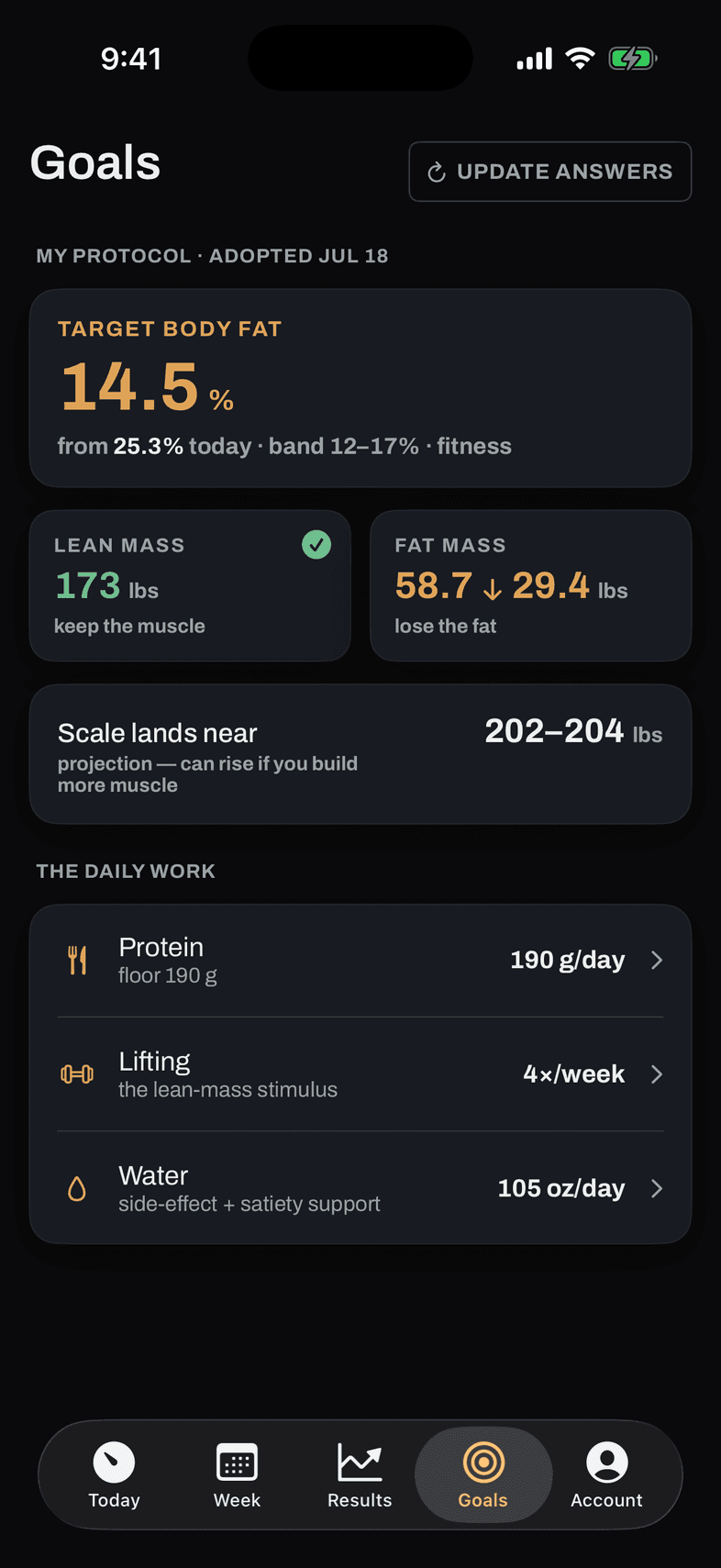
One screen carries the argument.
Your numbers, not the population's
The engine sizes protein to the fat-free mass in your record and recalculates as it moves. The fat and lean lines live on the Results screen; Goals is where the targets come from.
- Fat mass and lean mass held apart, never merged into one total
- Protein target recalculated whenever the lean-mass reading moves
- Injections and dose changes dated in the same record as the trend
Where these numbers come from
- 01
Diabetes, Obesity and Metabolism · 2026 · Eisa N, Barood O. Diabetes Obes Metab. 2026;28(6):4818–4827. doi:10.1111/dom.70666. PMID 41877354.
- 02
Aerobic or Resistance Exercise, or Both, in Dieting Obese Older Adults
New England Journal of Medicine · 2017 · Villareal DT, et al. N Engl J Med. 2017;376(20):1943–1955
- 03
International Journal of Sport Nutrition and Exercise Metabolism · 2014 · Helms ER, et al. Int J Sport Nutr Exerc Metab. 2014;24(2):127–138
- 04
Sarcopenia: revised European consensus on definition and diagnosis
Age and Ageing · 2019 · Cruz-Jentoft AJ, et al. EWGSOP2. Age Ageing. 2019;48(1):16–31
- 05
Diabetes, Obesity and Metabolism · 2025 · Gregorič N, Šikonja J, Janež A, Jensterle M. Diabetes Obes Metab. 2025;27(2):519–528
GLP-1 muscle loss for men, answered
Do men lose muscle on GLP-1 medications?
Anyone losing weight fast loses some lean mass: in pooled DEXA and MRI trials, 25–39% of the loss, a range across drug arms that cannot rank one medication against another. What is specific to a man over 40 is the starting point: age-related muscle decline is already underway, and muscle lost now rebuilds more slowly.
Why does a man's protein target differ from a woman's?
Men carry more fat-free mass, so the same per-kilogram rule lands on a bigger number, and the floor differs too. Bild Health computes 2.4 g per kilogram of fat-free mass in a deficit, easing to 2.0 near goal. A man's target never falls below 80 g, whatever the formula says.
Is strength loss on a GLP-1 normal?
The one small trial that measured it (10 people, 12 weeks) found grip and leg strength unchanged while lean mass fell, far too small to settle anything. Which is exactly why loads sliding week over week deserve attention instead of a shrug: falling strength beside a falling lean-mass line is a chart for your prescriber, not a feeling.
How much lifting does it take to keep muscle on a GLP-1?
The best randomized evidence comes from dieting adults 65 and over: exercising three times a week, the arms that lifted lost 2–3% of their lean mass while the cardio arm lost 5%, on the same diet. Two to three sessions a week that actually progress is the pattern our full guide builds on.
Does semaglutide affect testosterone?
One open-label trial (25 men with obesity, type 2 diabetes and weight-linked low testosterone, on semaglutide 1 mg) found total testosterone rising as weight fell; free testosterone did not move significantly. That points to the weight loss improving the picture, not the drug acting on hormones. Anyone promising hormonal effects is ahead of the evidence; your own labs go to your prescriber.
Related pages
- How to Keep MuscleOzempic Muscle Loss: How to Keep Muscle on a GLP-1
- DEXA vs. Smart ScaleAre Body Fat Scales Accurate? DEXA vs. Smart Scale
- Protein CalculatorProtein Calculator for GLP-1
- Zepbound TrackerZepbound App: The Tracker That Shows Fat vs. Muscle
- Muscle Loss CalculatorGLP-1 Muscle Loss Calculator
- The ScienceThe Science Behind Bild Health: Muscle, Fat, and GLP-1s
Keep the muscle you'd have to rebuild.
Bild Health keeps fat mass, lean mass, protein, training and your dose history in one record. The lean number is measured from your scale, anchored by imported DEXA scans.
Lose the fat. Keep the muscle.